Mr g by Alan Lightman
Writing good fiction is hard. Writing good science is even harder. From what I've come across over the years, science-based fiction (not science fiction) is a rare talent to be praised. Mr Lightman began his career as a physicist, specializing in astrophysics, and for twenty years, held a distinguished career in astronomy through MIT.
Then he started writing. With previous (and somewhat esoteric) work such as Einstein's Dreams and Good Benito, Lightman's talents have come to lay in weaving descriptive prose with a scientist's curious and detailed view of the Universe.
Which brings us to Mr g.The unnamed narrator, at the beginning of the book, wakes up from a very long nap and decides to create a universe. In this story of Creation as told from the perspective of the Creator, we can see the development of geometric, scientific, mathematical, and physical ideas as the narrator builds concepts such as space and time from the infinite nothingness of the Void, where he lives with his argumentative aunt and uncle. The creator is at his core a curious personality, learning by trial-and-error as he builds, and rebuilds universes of varying dimension, geometries, logical consistences, and stability. He loves to watch his creations simply grow and change, and see how they react to stimuli, such as introduction of "organizational principles" and laws of physics.
His favorite project begins with Aalam-104729 (the name originates with His Uncle Deva's penchant for creative naming, and the 10,000th prime number, so he doesn't lose track of it amid the billions of other universes), which His Aunt Penelope randomly selects for him, encouraging that He "take His time with this one, and not rush into things." As Mr g (He is never actually referred to as such in the book, but I'm running out of things to call Him) launches Aalam-104729 by enriching it with symmetry concepts, a simple three dimensions of space, physical laws, and finally matter, which erupts in a fantastic explosion, He is delighted to simply watch his creation grow.
As a strict non-interventionist, the narrator is highly concerned with proper cause-and-effect, in which His own actions should not meddle with the internal workings as the universe unfolds of its own accord, and in a beautiful chaos, developing elementary particles, stars, planets, and eventually biology. His foil, however, has a somewhat more active philosophy. Soon after the creation of Aalam-104729, the tall, whip-smart, and elusive Belhor arrives with an interest in the new creation. While not "the devil" per se, Belhor represents Mr g's intellectual equal, who often serves as a balancing sounding board for ideas concerning thornier issues when conscious life arises, such as morality, and the overarching philosophy of a "disinterested" god who allows beings to suffer.
Perhaps the most compelling moral discussion in the novel is the narrator's discussion with His uncle, who is lobbying for the creation of an immortal soul for conscious beings; the creator is hesitant, well-knowing that a mind from the material universe would not be able to comprehend the Void beyond existence. With input from Belhor, and Uncle Deva, the idea of the beings having an actual connection beyond their universe is a heavy decision for the creator.
While being an exceptionally quick read, Lightman's work weaves together concepts ranging wide from mathematics, science, and philosophy, as taken by someone who has very good reason to consider the impacts of each of His ideas. The science, form the Big Bang to the End, is wonderfully expressed in the text as we read the life story of the universe, and its creator's pure love for all that it is. This is an excellent read for anyone with even a passing interest in philosophy or science, with a shift of perspective to the Outside which only a deity could appreciate
Showing posts with label science. Show all posts
Showing posts with label science. Show all posts
07 March, 2012

22 December, 2009

Unscientific America by Chris Mooney and Sheril Kirshenbaum
My process for reading books is never quite as fast as I would like it to be... this inevitably results in always adding more to the eternally growing list of to-reads. For this reason, as much as I enjoy books of the zeitgiest, they too often loose their great impact before I get a chance to comb through the pages. Unscientific America, in this mold, operates very much within the moment; clearly researched in late 2008, and written/published in early 2009, Mooney & Kirshenbaum's work is an extension from Mooney's 2005 Republican War on Science (recommended reading). However, rather than taking aim at a particular political philosophy, the authors have a greater focus upon the American people's malaise and insouciance of the scientific world.
A relatively short work (about 150 pages), but very clear and to the point, the book rose from the failed effort of ScienceDebate2008, an effort during the 2008 presidential election to bring Senators Obama and McCain to a forum in which the scientific issues of the day were discussed (in the same way of the values debate, economy debate, etc...). The Obama campaign politely declined requests, and the McCain camp simply ignored any discussion of the topic. Good idea though, right? A lot of universities, professional researchers, and members of the educated community thought so too. The simple reason why the campaigns declined (or ignored) the idea of discussing American science in a highly public forum was that there was no reason to-- a presidential campaign is purely an animal of survival-- the quadrennial campaign is as lean and as close to public sentiment as metaphorically possible.But why don't Americans like to talk about science?
"Of course we're intimidated by science! Science holds itself above everybody else-- above God, evidently. You guys have been kicking ass since the Enlightenment"
-Stephen Colbert
A quick history of the American relationship with the scientific community through the latter half of the 20th century (although not as cutting or encompassing as in Mooney's earlier work) brings us to the state of science of 2009, after eight years of an outright antiscience adminstration, culture wars on man's origin, stem cells, and some topics you would never think would be debated, to ask where are we now, and where are we going?
[For a full jeremiad about the declining place of science in America, please see older posts.]
While it would be easy to place blame upon the populace for scientific lassitude, Mooney and Kirshenbaum are equanimitous in spreading blame to scientists for popular disconnect. While American interest in scientific advances have consistently slipped in that last fifty years, science itself has become more obtuse-- beautiful, encompassing, and wonderful-- but largely abstract to the general population.
Communication of science, the authors argue, is the greatest failing of the American science-culture system. While science writers have been declining in the waning years of newspapers, the scientists themselves are often left to communicate the wonder of their art to the people, which has simply ne
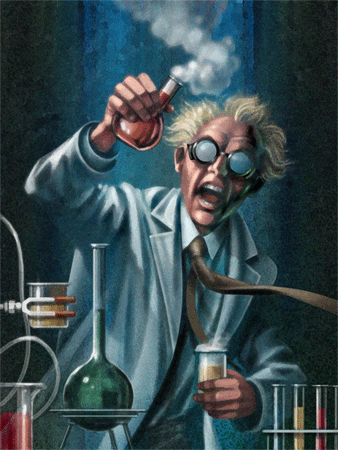 ver been a high priority, as researchers themselves prefer research, and there has always been science writers to serve as a medium.This might be why so many Americans hear "scientist" and think of something like this:
<------------
when, in reality, so many of us are

more like this --------------->
Okay, not always beakers, but beer pints instead, and not as much dyed hair. But we do rock the fuck out.
Anyway, the book. In the end, there really is no one place or person to hang all of the blame for the problems with how Americans do or do not embrace science. For all that we bemoan and cringe at the actively antiscience population, the truth is that most of our countrymen (and women) are actually very respectful of science and interested when it does pop-up in an understandable form. What is necessary is a new culture, which is actually quite fortunate, as American culture has shown us, it is malleable and powerful when concentrated. Let's not let this decade's ascendancy of the geek stop with a complacency that the Bush years are over, there is always a great amount of work to be done. It can always be better. Both scientists and Americans are defined by a strong attachment and dedication to consistent, hard work. Both are capable.
04 September, 2009
More thoughts on a book.
My most recent read took me much longer to get through than I would have liked, but it was well worth it. The Age of Wonder by Richard Holmes is a history of science through the Romantic Era (1780 s-1830s) told through English science. Possibly the best nonfiction I've read in some time, Holmes himself appears to be more of an historian of romanticist literature and history, and in the undying words of my brother-in-law, an "englishist." What sets this apart from many of the other scientific histories I've read is Holmes' sense of literature and poetry itself. The story-telling like style (focusing primarily on three figures in English science, Joseph Banks, William Herschel, and Humphrey Davy) does a wonderful job of telling the interconnectedness of science, philosophy, literature, politics, and society readily apparent in 18th century society as it is today. Indeed, it was not uncommon for the likes of the young Michael Faraday or Caroline Herschel to have had dinner parties and correspondence with the literary and philosophical luminaries such as Coleridge, Keats, Wordsworth, the Shelleys, Lord Byron, and Kant.
Personally, I have always had an affection for romanticist works, in its epic grasp of all love, hope, power, beauty, misery and trembling universality. What really pulled this book together was the recognition that science and poetry themselves are in fact two sides of the same coin: in searching for the innate beauty of the world. The story of tropic, polar, aerial, electric, and chemical exploration in as the eighteenth century passed into the nineteenth has a true sense of its place in history as well. Politically, the romanticists saw the mental decline of George III, the loss of the American colonies, Napoleon's rise, fall and rise again, the establishment of the Regency, and eventually the passage into the Victorian era with her coronation in 1837. Moreover, as so many places in history show, a time of philosophical transition (called "paradigm shifts" by Thomas Kuhn) is truly fascinating... in the early Industrial Era, Britain and Europe as a whole was beginning to shake off the last of the medieval hangers-on. Much of science in the early modern era (16th-early 18th c.) was closely tied to philosophy and religion of the time. Many men of science were deeply pious (such as Newton, Kepler, Galileo), and spoke freely of God in their writings; however, their view of the cosmos, as soon through the lens of the natural world led to the rise of Deist philosophies in the 1700s. By the end of the 1800s, "natural philosophy" which often speculated on the nature of Creation and of Man as well as its subject manner evolved into the science we know today, objectively of its own philosophies.
Many interpreters of Romantic poetry cite Coleridge and Keats as decrying science as robbing nature of is mystery and beauty. Holmes, however, attacks this interpretation, showing how in literature itself of the era, scientists are to be highly praised and loved as those who can truly see the magnificent, beautiful, unity of the Universe. Seen through the awe-inspiring knowledge when Herschel announced an infinite Universe with worlds beyond our imagination. It was seen in Davy's initial exploration into gases and human consciousness itself. This was seen when French ballooneers first saw the world from on top.... when looking down, human borders and faults melted away into the beauty of a landscape from miles up.
I've been making mental notes for myself to get poetry books off of the shelf now that I've read this. It is always an amazing reminder to see the world itself as a living poem
My most recent read took me much longer to get through than I would have liked, but it was well worth it. The Age of Wonder by Richard Holmes is a history of science through the Romantic Era (1780
s-1830s) told through English science. Possibly the best nonfiction I've read in some time, Holmes himself appears to be more of an historian of romanticist literature and history, and in the undying words of my brother-in-law, an "englishist." What sets this apart from many of the other scientific histories I've read is Holmes' sense of literature and poetry itself. The story-telling like style (focusing primarily on three figures in English science, Joseph Banks, William Herschel, and Humphrey Davy) does a wonderful job of telling the interconnectedness of science, philosophy, literature, politics, and society readily apparent in 18th century society as it is today. Indeed, it was not uncommon for the likes of the young Michael Faraday or Caroline Herschel to have had dinner parties and correspondence with the literary and philosophical luminaries such as Coleridge, Keats, Wordsworth, the Shelleys, Lord Byron, and Kant.Personally, I have always had an affection for romanticist works, in its epic grasp of all love, hope, power, beauty, misery and trembling universality. What really pulled this book together was the recognition that science and poetry themselves are in fact two sides of the same coin: in searching for the innate beauty of the world. The story of tropic, polar, aerial, electric, and chemical exploration in as the eighteenth century passed into the nineteenth has a true sense of its place in history as well. Politically, the romanticists saw the mental decline of George III, the loss of the American colonies, Napoleon's rise, fall and rise again, the establishment of the Regency, and eventually the passage into the Victorian era with her coronation in 1837. Moreover, as so many places in history show, a time of philosophical transition (called "paradigm shifts" by Thomas Kuhn) is truly fascinating... in the early Industrial Era, Britain and Europe as a whole was beginning to shake off the last of the medieval hangers-on. Much of science in the early modern era (16th-early 18th c.) was closely tied to philosophy and religion of the time. Many men of science were deeply pious (such as Newton, Kepler, Galileo), and spoke freely of God in their writings; however, their view of the cosmos, as soon through the lens of the natural world led to the rise of Deist philosophies in the 1700s. By the end of the 1800s, "natural philosophy" which often speculated on the nature of Creation and of Man as well as its subject manner evolved into the science we know today, objectively of its own philosophies.
Many interpreters of Romantic poetry cite Coleridge and Keats as decrying science as robbing nature of is mystery and beauty. Holmes, however, attacks this interpretation, showing how in literature itself of the era, scientists are to be highly praised and loved as those who can truly see the magnificent, beautiful, unity of the Universe. Seen through the awe-inspiring knowledge when Herschel announced an infinite Universe with worlds beyond our imagination. It was seen in Davy's initial exploration into gases and human consciousness itself. This was seen when French ballooneers first saw the world from on top.... when looking down, human borders and faults melted away into the beauty of a landscape from miles up.
I've been making mental notes for myself to get poetry books off of the shelf now that I've read this. It is always an amazing reminder to see the world itself as a living poem
12 August, 2009
So I just finished an interesting biography about John Dee. For those who (understandably) have not heard of Dr. Dee, he was a 16th century philosopher/scientist/sorcerer/astrologer under Elizabeth I. Lately, I've taken a fascination with early modern era science, that is, the beginning of what we consider science. Prior to this, the ideas of "natural philosophy" (as it was called until the 18th century) was largely indistinguishable from magic. Astronomy grew from astrology; chemistry grew from alchemy; this transition I find personally fascinating, and much of the builders of early science had one foot in the rigorous method of experimentation which we recognize today and the other in ancient mysticism which has its roots deep into Antiquity.
The Queen's Conjurer by Benjamin Woolley (2001) is Dee's story, trying to show his roots as both an early scientist and the fount of much modern-day mysticism in the West. It seems to me that John Dee's biggest issue is that he longed to have a full, comprehensive knowledge of Creation, both physical and spiritual (remember, no distinction in the 1500s of natural and supernatural), but never seemed to completely get out of the old ways. This is exemplary of English society of the time, split in a transition from Medieval to Modern, Catholic to Protestant, and even from Old Style calendars to New Style (unlike the Continent, England stuck to the Julian mode). The Jacobean Era beginning in 1604 arouse a different world which would be that of flourishing Galileo, Kepler, and Newton, who while they all had mage-like qualities, were explorers of the new age.
Much like Dee, who seems to see disappointment after disappointment, Woolley doesn't seem to quite get there. I went into this really looking forward to an engaging, mysterious figure who straddled the Old and the New of science and sorcery, but this book is so much more mired in Renaissance politics and the personal failings of Dr. Dee that I felt about halfway through, I was reading more to get the book done. Perhaps it's my interests when reading this sort of history, but the author tends to avoid the science which could have been marvelously interesting.
Dee's life itself is a bit of a disappointment. A true Renaissance man who seemed to be a wonderful polymath, truly devoted to the intoxication of pure knowledge seems like he should have had a much more interesting life. It starts off well, as a young man negotiating his survival in Mary Tutor's court, and early success with Queen Elizabeth. He travels, corresponds with Brahe and others, and begins his journey (I particularly love the story of his ill-fated great library). By middle age, he seems to abandon science for speaking to God's emissaries directly via crystalomancy. For reasons not quite described, he cannot do this himself, so he falls in with a scryer, Edward Kelley, who in my view, appears to be a world class scheister. Kelley sadly seems to control the otherwise brilliant Dr. Dee in the latter half of his life, largely controlling Dee's movements and career decisions, the majority of which appear to be disastrous.
While I certainly understand that writing a biography of a man born nearly 500 years ago, that sources are scantly few and far between, making this sort of work frustratingly difficult (not that I wouldn't be opposed to trying this myself someday), Woolley appears to rely a great deal on his own interpretations and reading between the lines. Don't let this make you think that the work is poorly researched-- indeed, I have a great respect for the book, has an exhaustively wonderful 43 page notes/bibliography section. So much just feels disappointing in that like John Dee himself, The Queen's Conjurer is something that was destined for wonderful things but sadly fell short.
On the other hand, I am now very interested in finding another Dee bio just to have a look at what else it out there.
The Queen's Conjurer by Benjamin Woolley (2001) is Dee's story, trying to show his roots as both an early scientist and the fount of much modern-day mysticism in the West. It seems to me that John Dee's biggest issue is that he longed to have a full, comprehensive knowledge of Creation, both physical and spiritual (remember, no distinction in the 1500s of natural and supernatural), but never seemed to completely get out of the old ways. This is exemplary of English society of the time, split in a transition from Medieval to Modern, Catholic to Protestant, and even from Old Style calendars to New Style (unlike the Continent, England stuck to the Julian mode). The Jacobean Era beginning in 1604 arouse a different world which would be that of flourishing Galileo, Kepler, and Newton, who while they all had mage-like qualities, were explorers of the new age.
Much like Dee, who seems to see disappointment after disappointment, Woolley doesn't seem to quite get there. I went into this really looking forward to an engaging, mysterious figure who straddled the Old and the New of science and sorcery, but this book is so much more mired in Renaissance politics and the personal failings of Dr. Dee that I felt about halfway through, I was reading more to get the book done. Perhaps it's my interests when reading this sort of history, but the author tends to avoid the science which could have been marvelously interesting.
Dee's life itself is a bit of a disappointment. A true Renaissance man who seemed to be a wonderful polymath, truly devoted to the intoxication of pure knowledge seems like he should have had a much more interesting life. It starts off well, as a young man negotiating his survival in Mary Tutor's court, and early success with Queen Elizabeth. He travels, corresponds with Brahe and others, and begins his journey (I particularly love the story of his ill-fated great library). By middle age, he seems to abandon science for speaking to God's emissaries directly via crystalomancy. For reasons not quite described, he cannot do this himself, so he falls in with a scryer, Edward Kelley, who in my view, appears to be a world class scheister. Kelley sadly seems to control the otherwise brilliant Dr. Dee in the latter half of his life, largely controlling Dee's movements and career decisions, the majority of which appear to be disastrous.
While I certainly understand that writing a biography of a man born nearly 500 years ago, that sources are scantly few and far between, making this sort of work frustratingly difficult (not that I wouldn't be opposed to trying this myself someday), Woolley appears to rely a great deal on his own interpretations and reading between the lines. Don't let this make you think that the work is poorly researched-- indeed, I have a great respect for the book, has an exhaustively wonderful 43 page notes/bibliography section. So much just feels disappointing in that like John Dee himself, The Queen's Conjurer is something that was destined for wonderful things but sadly fell short.
On the other hand, I am now very interested in finding another Dee bio just to have a look at what else it out there.
25 April, 2008
There exists a generation in America who has not seen a man on the Moon. The Apollo program exists to anyone younger than thirty years simply as history, as if those born in the final quarter of the 20th century have only known the dying echo of that which once was a thunderous roar. Of the many reasons NASA abandoned the Apollo program in the mid-1970s was a lack of public interest. For those who can only faintly recall a time without computers, a national space program consists of varied probes, satellites, and telescope images, of which the public as a whole is only temporarily aware, if at all interested.
As a member of “Generation Y,” Americans born in the 1980s and 1990s, I have been very fortunate to enjoy the fruits of our nation’s boisterous economic success — particularly in the previous decade — for much of my life. Indeed, many Americans of all walks of life, as well as millions beyond our shores, have benefited from the American scientific and technological innovations of the late 20th century.
These great leaps over the previous half-century are doubtlessly attributed to the “Sputnik Generation,” who came of adult age beginning in the 1970s. At the height of the Cold War, the federal government—not to be outdone by Soviet achievements— heavily invested in both basic research as well as science education. These investments later manifested themselves primarily in (1) the American victory in the “Race to the Moon” (which subsequently produced much-needed computer miniaturization and empowerment), as well as (2) a generation of Americans whose enthusiasm and training in science and technology fostered characteristic American innovation, invention and discovery, pushing the bounds of both our civilization’s knowledge and ability.
However, in recent years the United States’ governmental and public interest in the sciences has waned. Although a definitive point when the Cold War-fueled interest in sciences began to lose momentum is difficult to ascertain, some of the largest blows to the American scientific community have occurred since the dismantling of the congressional Office of Technology Assessment in 1995. Moreover, science has suffered greatly over the past eight years, particularly in the form of a dearth in funding for basic research and science education. Indeed, this can be easily shown by a plateauing for NSF and DOE funding (only DOD and NASA saw an increase) in recent years, as well as dropping test scores in science and mathematics.
Indeed, with the current state of American science and science education, the republic finds itself at a precipitating crisis; given the rapid investment in these fields by rising 21st century powers, such as China and India, America’s cultural, political, and economic standing for future generations is in jeopardy. The global centers of learning have begun to shift away from our shores—such an example is the Large Hadron Collider in Europe, which will provide groundwork for the next step in physics, was originally planned to be built in Waxahachie, Texas over ten years ago until this plan was abandoned by lawmakers. While a generation ago, NASA was a sparkling source of pride for all Americans; the space agency today is regarded on the whole with ambivalence, if not ridicule. The United States must lead again.
To use history as a guide, one may draw parallels with a nation’s investment in science and technology with later economic and political success. This pattern begins to emerge in antiquity among the Greeks and later Romans; and is followed in world history through the Enlightenment in British advances in the physical sciences seeding global dominance in the 19th century. Indeed, this is continued in the American story through scientific and technological investment the early- to mid-20th century to today’s unparalleled achievement at the dawn of the millennium.
Of a nation borne of Enlightenment principles, the very idea United States rests upon an informed citizenry. It is only the knowledgeable citizen who will question authority, it is only the conversant citizen to will hold their leaders accountable, it is only the well-informed citizen who will consider the impact of their vote, their purchase, and their very life. America deserves no less than an enlightened community of informed, active citizens.
In the coming decades, the must be a renewal. To re-present science to the population is no small undertaking, yet as a people, Americans are defined by their incredible capacity to be at their best in the worst of times. This revolution of thought will require enormous resources, time, and investment in an incredibly American channel of discussion: public education. American students routinely rank far behind those of other developed nations, and with a slipshod, piecemeal approach to invigorating American schools; these rankings are bound only to slide further. Yet, in a time of an educational nadir, Americans do have the mountain-moving capacity to launch a New Deal for schools, an Apollo program for learning. This is our strength, and we will show that a strong America will be built through strong schools.
Our leaders must be pressed as to how they will show their support for basic research. American science will push the bounds of our collective knowledge and show the world new horizons. Today, many scholars from abroad are being drawn back to their homelands, and bringing their vital American-acquired talents and knowledge away with them—let us build an America where study and exploration are held to the highest standards of public discourse and admiration.
As the world seeks to define itself in the twenty-first century, challenges appear to all mankind which were unimaginable a generation before—an ever-shrinking world through globalization and the Internet, the hegemony of a single superpower, economies as entropic as the weather, and spectre global climate change. Our nation must hold a leadership role in solving some of the most complex and severe problems in human history. This task requires no less than the enlightened republic which the Founders hoped it would be.
This year, we find ourselves in an opportune moment to take our nation where it must be. During this presidential election, the advocacy of science in the American psyche can hold a unique place to be able to spread its message to the voters as well as the candidates. Should science be pushed into the top priorities of the next president, America will have the leader it needs to inspire a new generation. Nearly a half-century ago, President Kennedy asked Americans to go to the Moon; this feat was not only accomplished by the Herculean advances of NASA, laboratories, and in the bravery of the pioneering pilots, but also in the enthusiastic backing and will of the American people, who dutifully and excitedly watched the liftoff of every spacecraft. We, as a people, are capable of so many things…. Americans need only to be challenged.
As a member of “Generation Y,” Americans born in the 1980s and 1990s, I have been very fortunate to enjoy the fruits of our nation’s boisterous economic success — particularly in the previous decade — for much of my life. Indeed, many Americans of all walks of life, as well as millions beyond our shores, have benefited from the American scientific and technological innovations of the late 20th century.
These great leaps over the previous half-century are doubtlessly attributed to the “Sputnik Generation,” who came of adult age beginning in the 1970s. At the height of the Cold War, the federal government—not to be outdone by Soviet achievements— heavily invested in both basic research as well as science education. These investments later manifested themselves primarily in (1) the American victory in the “Race to the Moon” (which subsequently produced much-needed computer miniaturization and empowerment), as well as (2) a generation of Americans whose enthusiasm and training in science and technology fostered characteristic American innovation, invention and discovery, pushing the bounds of both our civilization’s knowledge and ability.
However, in recent years the United States’ governmental and public interest in the sciences has waned. Although a definitive point when the Cold War-fueled interest in sciences began to lose momentum is difficult to ascertain, some of the largest blows to the American scientific community have occurred since the dismantling of the congressional Office of Technology Assessment in 1995. Moreover, science has suffered greatly over the past eight years, particularly in the form of a dearth in funding for basic research and science education. Indeed, this can be easily shown by a plateauing for NSF and DOE funding (only DOD and NASA saw an increase) in recent years, as well as dropping test scores in science and mathematics.
Indeed, with the current state of American science and science education, the republic finds itself at a precipitating crisis; given the rapid investment in these fields by rising 21st century powers, such as China and India, America’s cultural, political, and economic standing for future generations is in jeopardy. The global centers of learning have begun to shift away from our shores—such an example is the Large Hadron Collider in Europe, which will provide groundwork for the next step in physics, was originally planned to be built in Waxahachie, Texas over ten years ago until this plan was abandoned by lawmakers. While a generation ago, NASA was a sparkling source of pride for all Americans; the space agency today is regarded on the whole with ambivalence, if not ridicule. The United States must lead again.
To use history as a guide, one may draw parallels with a nation’s investment in science and technology with later economic and political success. This pattern begins to emerge in antiquity among the Greeks and later Romans; and is followed in world history through the Enlightenment in British advances in the physical sciences seeding global dominance in the 19th century. Indeed, this is continued in the American story through scientific and technological investment the early- to mid-20th century to today’s unparalleled achievement at the dawn of the millennium.
Of a nation borne of Enlightenment principles, the very idea United States rests upon an informed citizenry. It is only the knowledgeable citizen who will question authority, it is only the conversant citizen to will hold their leaders accountable, it is only the well-informed citizen who will consider the impact of their vote, their purchase, and their very life. America deserves no less than an enlightened community of informed, active citizens.
In the coming decades, the must be a renewal. To re-present science to the population is no small undertaking, yet as a people, Americans are defined by their incredible capacity to be at their best in the worst of times. This revolution of thought will require enormous resources, time, and investment in an incredibly American channel of discussion: public education. American students routinely rank far behind those of other developed nations, and with a slipshod, piecemeal approach to invigorating American schools; these rankings are bound only to slide further. Yet, in a time of an educational nadir, Americans do have the mountain-moving capacity to launch a New Deal for schools, an Apollo program for learning. This is our strength, and we will show that a strong America will be built through strong schools.
Our leaders must be pressed as to how they will show their support for basic research. American science will push the bounds of our collective knowledge and show the world new horizons. Today, many scholars from abroad are being drawn back to their homelands, and bringing their vital American-acquired talents and knowledge away with them—let us build an America where study and exploration are held to the highest standards of public discourse and admiration.
As the world seeks to define itself in the twenty-first century, challenges appear to all mankind which were unimaginable a generation before—an ever-shrinking world through globalization and the Internet, the hegemony of a single superpower, economies as entropic as the weather, and spectre global climate change. Our nation must hold a leadership role in solving some of the most complex and severe problems in human history. This task requires no less than the enlightened republic which the Founders hoped it would be.
This year, we find ourselves in an opportune moment to take our nation where it must be. During this presidential election, the advocacy of science in the American psyche can hold a unique place to be able to spread its message to the voters as well as the candidates. Should science be pushed into the top priorities of the next president, America will have the leader it needs to inspire a new generation. Nearly a half-century ago, President Kennedy asked Americans to go to the Moon; this feat was not only accomplished by the Herculean advances of NASA, laboratories, and in the bravery of the pioneering pilots, but also in the enthusiastic backing and will of the American people, who dutifully and excitedly watched the liftoff of every spacecraft. We, as a people, are capable of so many things…. Americans need only to be challenged.
Subscribe to:
Posts (Atom)