Showing posts with label future. Show all posts

26 December, 2009


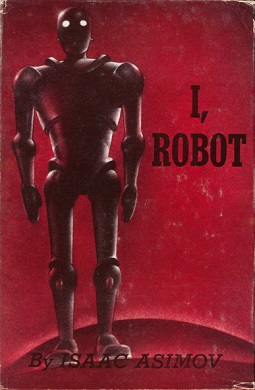
I, Robot by Isaac Asimov

To begin with, while there are many editions of many books out there, the cover art that normally goes up with these reviews is that of the edition which I read. The physical book beside me right now is the 2004 printing, which my brother loaned to me (thanks Will!). Unfortunately, this was the same year in which a film of the same title, that had little to do with the novel, premiered. As I was holding a cheap paperback in which Will Smith glared at me with a vaguely futuristic and ominous, if worried countenance.

{damnit, Will Smith, cut that out}

Firstly, just about anyone who has read Asimov places him as the father of modern science fiction, and from what I have read of his early work (Foundation trilogy, "Nightfall"), I can agree an overflowing imagination and use of fundamental science are the principles of his work are highlights of Asimovian sci-fi.

More than anything else, Asimov constructs an entire universe around his fiction, in which he employs a similar method as Foundation, as telling his narrative through a series of thematically-related, chronological short stories. The novel itself takes the form of a 2064 interview of the elderly Dr. Susan Calvin, a roboticist who shepherded the dawn of the robotic age. Dr. Calvin's second- and first-hand recollections of twenty-first century history from the simple robotics in the 1990s to the global-scale positronic brains of the 2060s is a series of accounts in which the human creators struggle with, understand, and learn about their own creations through the regular, logical actions of the machines.

Dr. Calvin herself is always described in the text as cold and emotionless, moreso than even her robotic subjects. The ever-logical and steadfast nature of this personality characterizes the book. Central to any of Asimov's description of robotkind are the Three Laws of Robotics:
  1. A robot may not harm a human being, or through inaction, allow a human being to come to harm
  2. A robot must obey any orders given by a human being, unless such orders conflict with the First Law
  3. A robot must protect its own existence, unless doing so conflicts with the First or Second Law
In fact, these Laws are so central to not only robots' existence, but are also entirely central to the plot of the book. Each of the nine short stories are reflections of how humans and robots interact with these Laws, and in each of the nine stories, the reader is consistently reminded of the Laws' text and importance. To be honest, it was a bit irritating after a while (I found myself screaming "Get on with it!" each time the characters reviewed these laws).

The concept of robopsychology as Calvin's field of study seems a bit abstract to me. As the entirety of robot's "personalities" are dictated by the Three Laws (and occasionally hints of the zeroth), one would think that any personality the robot would have would be rather straightforward and predictable, but then again, most of the stories in I, Robot are peculiar cases where behavior is unexplained. Or, I could study a bit more about artificial intelligence, even though it's always made me a bit paranoid. While Asimov's ideals about the Laws dictating all robotic behavior are wonderful (especially the bit about the positronic brain melting before harming a person), I feel that the real history of AI tilts to a more pragmatic robot which gets the job done, as programmed by its creators. Let's not forget that we do live in the future, after all.

The author should not be begrudged praise... this is a finely written book, with an excellent imagination for the era (1950), and if anything, I'm a bit disappointed that robots are not as benign and just as Asimov had hoped. At parts it is a dry read when compared to his more colorful work; but in truth, Asimov was a scientist by training, who saw the world as thoroughly organized and beautiful; while is work wonderfully operates within the laws of nature, I feel he greatly restrained endless possibilities of development by restricting the story to additionally operate within the laws of robotics.

Both the central character's and author's endless reverence for the positronic brain is appreciated, but as it is seen to some degree with Dr. Asmiov and to an almost misanthropic degree with Dr. Calvin, there was an overarching theme that the innate "goodness" of robots was always greater and more concrete than the goodness, abilities and creativity of mankind. Sure, the robots are infinitely rational and selfless and obedient, but don't count humans out of the game just yet. In the constructed 21st century of the novel, I'm probably one of the cranky old Fundamentalists who don't trust the mechanical men. I'm okay with that though (I'm going to be one of those awesome old guys who's always ranting about something and shaking a cane.... kids of the 2050s, watch out).

In fact, the developing field of artificial intelligence in all likelihood places what will be the real world's equivalent of the positronic brain in an interactive console that a move-around humanoid machine. Although no futurist (ask Ray Kurzweil for more details), the next decade or two will be staggerinly fascinating when a synthetic mind can consider us as we consider it. A field developing faster than the common press can keep up, this brings so much of what "science fiction" is to our daily lives. As usual, the only thing more fascinating than the dreams of fiction writers is when these are written by history.

To finish off, let's hope that these Three Laws do get programmed into our future mechanical overlords, and that we remind them that we are a good, benevolent race of squishy irrationals.

22 December, 2009


Unscientific America by Chris Mooney and Sheril Kirshenbaum

My process for reading books is never quite as fast as I would like it to be... this inevitably results in always adding more to the eternally growing list of to-reads. For this reason, as much as I enjoy books of the zeitgiest, they too often loose their great impact before I get a chance to comb through the pages. Unscientific America, in this mold, operates very much within the moment; clearly researched in late 2008, and written/published in early 2009, Mooney & Kirshenbaum's work is an extension from Mooney's 2005 Republican War on Science (recommended reading). However, rather than taking aim at a particular political philosophy, the authors have a greater focus upon the American people's malaise and insouciance of the scientific world.

A relatively short work (about 150 pages), but very clear and to the point, the book rose from the failed effort of ScienceDebate2008, an effort during the 2008 presidential election to bring Senators Obama and McCain to a forum in which the scientific issues of the day were discussed (in the same way of the values debate, economy debate, etc...). The Obama campaign politely declined requests, and the McCain camp simply ignored any discussion of the topic. Good idea though, right? A lot of universities, professional researchers, and members of the educated community thought so too. The simple reason why the campaigns declined (or ignored) the idea of discussing American science in a highly public forum was that there was no reason to-- a presidential campaign is purely an animal of survival-- the quadrennial campaign is as lean and as close to public sentiment as metaphorically possible.
But why don't Americans like to talk about science?

"Of course we're intimidated by science! Science holds itself above everybody else-- above God, evidently. You guys have been kicking ass since the Enlightenment"
-Stephen Colbert

A quick history of the American relationship with the scientific community through the latter half of the 20th century (although not as cutting or encompassing as in Mooney's earlier work) brings us to the state of science of 2009, after eight years of an outright antiscience adminstration, culture wars on man's origin, stem cells, and some topics you would never think would be debated, to ask where are we now, and where are we going?

[For a full jeremiad about the declining place of science in America, please see older posts.]

While it would be easy to place blame upon the populace for scientific lassitude, Mooney and Kirshenbaum are equanimitous in spreading blame to scientists for popular disconnect. While American interest in scientific advances have consistently slipped in that last fifty years, science itself has become more obtuse-- beautiful, encompassing, and wonderful-- but largely abstract to the general population.

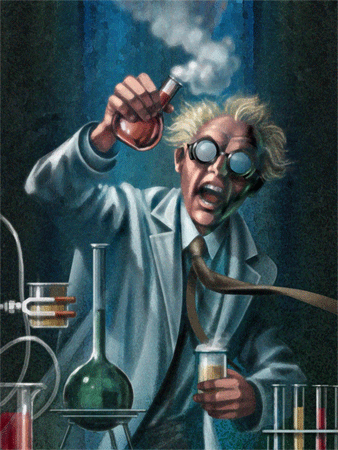
Communication of science, the authors argue, is the greatest failing of the American science-culture system. While science writers have been declining in the waning years of newspapers, the scientists themselves are often left to communicate the wonder of their art to the people, which has simply never been a high priority, as researchers themselves prefer research, and there has always been science writers to serve as a medium.This might be why so many Americans hear "scientist" and think of something like this:
<------------

when, in reality, so many of us are
more like this --------------->

Okay, not always beakers, but beer pints instead, and not as much dyed hair. But we do rock the fuck out.


Anyway, the book. In the end, there really is no one place or person to hang all of the blame for the problems with how Americans do or do not embrace science. For all that we bemoan and cringe at the actively antiscience population, the truth is that most of our countrymen (and women) are actually very respectful of science and interested when it does pop-up in an understandable form. What is necessary is a new culture, which is actually quite fortunate, as American culture has shown us, it is malleable and powerful when concentrated. Let's not let this decade's ascendancy of the geek stop with a complacency that the Bush years are over, there is always a great amount of work to be done. It can always be better. Both scientists and Americans are defined by a strong attachment and dedication to consistent, hard work. Both are capable.

14 November, 2009


The Martian Chronicles,
Ray Bradbury

I've been a fan of Bradbury's work on and off for a long time. A short story he wrote about a girl on Venus struck me in 7th grade as one of the first literary pieces of science fiction I had read. Fahrenheit 451 is, of course, a classic which will never die, and arguably his greatest work (this novel is particularly interesting as Bradbury more recent activities include being a cranky old man who protests when libraries close).

Last year, my interest in literary sci-fi started again, when I picked-up out copy of The Illustrated Man, a collection of stories told in a fascinating, if dark, prose which tumbled out of Bradbury's prolific imagination. The Martian Chronicles is created along the same vein, in the author's own words, "a book of stories pretending to be a novel."

The series of 26 vignettes are a history of mankind's exploration and settlement of the Red Planet, from 1999 to 2026. A few of these episodes were published on their own as short stories in the late 1940s, and appear primarily as thought explorations for the the future of Mars from the mid-20th century perspective. When these stories were ultimately pulled together as a single narrative in 1950, Bradbury's presentation of the future is done in the classic futurism stylization of the era.

In many parts, a thinly veiled description of early friction between human explorers and the native Martians is the classic science fiction model of criticism of the present/past (i.e., Manifest Destiny) by stories of the future. Indeed, the chapter "Way in the Middle of the Air" is a direct social critique of contemporary racial attitudes in the era (to the old Confederacy's credit,South which Bradbury paints in 2003 is much worse than it actually turned out to be).

There exists a certain joy(?) is reading of the past's predicts about today. In the often-bemoaned complain of 21st century life, "where is my jetpack?" decades past has set us up for disappointment (however, let's not forget about our robot cleaner houseservants). From the lens of the futurists of the post-War period, lunar bases and cities would be mainstream by the time of my birth and Martian colonization (if not terraforming) would begin around the turn of the century. As someone with a degree in astronomy, I found myself suppressing the "aw, that's cute" ideas of 1940s planetology which had blue Martian skies, temperate weather, and flowing canals of water (not to mention that this was the Venus was said to have extensive jungles and contant rainfall); however, we always forgive, because Mr. Bradbury was, in fact, using some of the better science of his time, and focus instead on the content of the story.

Early explorations and interactions with native Martian (or Tyrr, as they call their home) peoples are... odd. One would expect our First Contact, of course, to be beyond anything within our experience. These early encounters are somewhat fanciful and bizarre, however, these give way to an eventual human dominance era, in which the drama takes on a more familiar tone (ask a Wampanoag about smallpox if you want to see an older version of the story). Once the Mars is in the hands of humankind, and exploration gives way to settlement and colonization, a darker, if cynical storyteller appears which seems more reminiscent of Fahrenheit 451, and some of the darker stories of the Bradbury canon.

What is the future always about? Today. All considering, this book did actually make me a bit hopeful, for all of the destruction and calamity predicted at the dawn at the Atomic Era-- 64 years since our greatest sin against the atom, and there have only been two cities we've annihilated in this manner. For all of the shiny, Jetsons-eqsue hopes the 1950s had for the present day, there was a bleak, hollowed-out interior of fear as the early Cold War waged more in the minds of the world than on battlefields. For all of the fears and hopes of tomorrow, we've let down many, but in our wisdom, avoided so much more.

25 April, 2008

There exists a generation in America who has not seen a man on the Moon. The Apollo program exists to anyone younger than thirty years simply as history, as if those born in the final quarter of the 20th century have only known the dying echo of that which once was a thunderous roar. Of the many reasons NASA abandoned the Apollo program in the mid-1970s was a lack of public interest. For those who can only faintly recall a time without computers, a national space program consists of varied probes, satellites, and telescope images, of which the public as a whole is only temporarily aware, if at all interested.
As a member of “Generation Y,” Americans born in the 1980s and 1990s, I have been very fortunate to enjoy the fruits of our nation’s boisterous economic success — particularly in the previous decade — for much of my life. Indeed, many Americans of all walks of life, as well as millions beyond our shores, have benefited from the American scientific and technological innovations of the late 20th century.
These great leaps over the previous half-century are doubtlessly attributed to the “Sputnik Generation,” who came of adult age beginning in the 1970s. At the height of the Cold War, the federal government—not to be outdone by Soviet achievements— heavily invested in both basic research as well as science education. These investments later manifested themselves primarily in (1) the American victory in the “Race to the Moon” (which subsequently produced much-needed computer miniaturization and empowerment), as well as (2) a generation of Americans whose enthusiasm and training in science and technology fostered characteristic American innovation, invention and discovery, pushing the bounds of both our civilization’s knowledge and ability.
However, in recent years the United States’ governmental and public interest in the sciences has waned. Although a definitive point when the Cold War-fueled interest in sciences began to lose momentum is difficult to ascertain, some of the largest blows to the American scientific community have occurred since the dismantling of the congressional Office of Technology Assessment in 1995. Moreover, science has suffered greatly over the past eight years, particularly in the form of a dearth in funding for basic research and science education. Indeed, this can be easily shown by a plateauing for NSF and DOE funding (only DOD and NASA saw an increase) in recent years, as well as dropping test scores in science and mathematics.
Indeed, with the current state of American science and science education, the republic finds itself at a precipitating crisis; given the rapid investment in these fields by rising 21st century powers, such as China and India, America’s cultural, political, and economic standing for future generations is in jeopardy. The global centers of learning have begun to shift away from our shores—such an example is the Large Hadron Collider in Europe, which will provide groundwork for the next step in physics, was originally planned to be built in Waxahachie, Texas over ten years ago until this plan was abandoned by lawmakers. While a generation ago, NASA was a sparkling source of pride for all Americans; the space agency today is regarded on the whole with ambivalence, if not ridicule. The United States must lead again.
To use history as a guide, one may draw parallels with a nation’s investment in science and technology with later economic and political success. This pattern begins to emerge in antiquity among the Greeks and later Romans; and is followed in world history through the Enlightenment in British advances in the physical sciences seeding global dominance in the 19th century. Indeed, this is continued in the American story through scientific and technological investment the early- to mid-20th century to today’s unparalleled achievement at the dawn of the millennium.
Of a nation borne of Enlightenment principles, the very idea United States rests upon an informed citizenry. It is only the knowledgeable citizen who will question authority, it is only the conversant citizen to will hold their leaders accountable, it is only the well-informed citizen who will consider the impact of their vote, their purchase, and their very life. America deserves no less than an enlightened community of informed, active citizens.
In the coming decades, the must be a renewal. To re-present science to the population is no small undertaking, yet as a people, Americans are defined by their incredible capacity to be at their best in the worst of times. This revolution of thought will require enormous resources, time, and investment in an incredibly American channel of discussion: public education. American students routinely rank far behind those of other developed nations, and with a slipshod, piecemeal approach to invigorating American schools; these rankings are bound only to slide further. Yet, in a time of an educational nadir, Americans do have the mountain-moving capacity to launch a New Deal for schools, an Apollo program for learning. This is our strength, and we will show that a strong America will be built through strong schools.
Our leaders must be pressed as to how they will show their support for basic research. American science will push the bounds of our collective knowledge and show the world new horizons. Today, many scholars from abroad are being drawn back to their homelands, and bringing their vital American-acquired talents and knowledge away with them—let us build an America where study and exploration are held to the highest standards of public discourse and admiration.
As the world seeks to define itself in the twenty-first century, challenges appear to all mankind which were unimaginable a generation before—an ever-shrinking world through globalization and the Internet, the hegemony of a single superpower, economies as entropic as the weather, and spectre global climate change. Our nation must hold a leadership role in solving some of the most complex and severe problems in human history. This task requires no less than the enlightened republic which the Founders hoped it would be.
This year, we find ourselves in an opportune moment to take our nation where it must be. During this presidential election, the advocacy of science in the American psyche can hold a unique place to be able to spread its message to the voters as well as the candidates. Should science be pushed into the top priorities of the next president, America will have the leader it needs to inspire a new generation. Nearly a half-century ago, President Kennedy asked Americans to go to the Moon; this feat was not only accomplished by the Herculean advances of NASA, laboratories, and in the bravery of the pioneering pilots, but also in the enthusiastic backing and will of the American people, who dutifully and excitedly watched the liftoff of every spacecraft. We, as a people, are capable of so many things…. Americans need only to be challenged.