59 > 41
The unfortunate part about writing before you go to bed is that as consciousness flees from your mind, and escaping with it is general cohesion and argument in any discussion. This is well-evidenced by my previous post.
To pick-up where it left off, the simple matter is that there are parliamentary tricks to deal with this situation. It is very likely, in fact, that any filibuster will be made at all-- this sort of stalling tactic is precisely that which no one needs, putting all incumbents in danger this November. The Republicans might be in the minority now, but there are 34 senators* who are not terribly interested in joining the growing unemployed numbers among their constituents.
*Interesting note-- of these 34, eighteen are Republicans and sixteen are Democrats. Even if we assume a total overturn in Senate elections this fall, this places the Democrats at a now 61 vote advantage with eighteen fresh faces. Nate Silver, you have inspired me.
Psychologically, it takes a lot to stand up and scream "No! This is who I am and you cannot change me!", and I will give this to the GOP. In fact, the psychological antonyms to this are such things as: consideration, empathy, avoiding conflict, avoiding extremes, thoughtfulness and reflection; those general trademarks of the left. It seems since the second red scare of seventy years ago, the progressives of American politics have been afraid of their own shadow-- their own belief. In the end (as so much of politics do), this comes down to high school sociology; a desire to move with the herd represses one natural tendancies. For so long, the left has played the game as defined by the right.... they have tried to be strong Democrats by either trying to be (1) the same as or (2) subservient to the Republican party.
Let the left be the left. Progressive has a meaning beyond its buzzwordiness.
Showing posts with label politics. Show all posts
Showing posts with label politics. Show all posts
21 January, 2010

24 December, 2009
The Revolution Will Not be MedicatedToday's news from the senate chamber is no less than fantastic. Really, I'm happy to see any motion on healthcare reform whatsoever; but to a very specific degree, does anyone else feel that this victory is Pyrrhic? Both the House and the Senate bills, which have yet to be reconciled, were near party-line votes (60-39 in Senate and 220-215 in the House) are the result of compromise followed by compromise, to the point where, while this bill will have its effects, no one really seemed happy with the end result.
Too often when learning/reading/listening about the healthcare debate, I want to throw my hands in the air and forget about it because, simply stated, where is this all going? Would a reform be e true revolution which is necessary. Regardless of one's political ilk, virtually everyone agrees that an overhaul is absolutely necessary, but there is severe disagreement about what to do about Americans' health insurance.
Throw it out.
That's it, throw it out. A certain, calming epiphany when I realized that this was the path-- healthcare needs a complete paradigm shift, a total revolution as to its purpose and existence. Why are we insured at all?
By definition, insurance is an agreed-upon, businesslike gamble. There's nothing wrong with this... in fact, much of modern life and commerce owes functionality to someone gambling that bad things won't happen. Every year, I spend hundreds of dollars on a gamble that I might find myself in an automobile accident-- I'm happy to have lost this wager every year, but it's nice to know that if I "win" and get the insurance company to pay out, it'll be helpful in the aftermath. All insurance is simply a gamble-- this is why certain religious groups such as the Amish and some Muslims do not participate in conventional forms.in·sur·ance
1 Coverage by contract whereby one party undertakes to indemnify or guarantee another against loss by a specified contingency or peril
Say what you will about gambling... coming from a town that relies on it, I see it as a fun vice when in control (as any other vice), but in the end, Americans can usually tell a good bet from a bad bet. I can wager that I won't crash my car or burn down my house by taking precautionary measures, and the respective insurance companies won't have to pay; in fact, I can continue being safe like this for years or even decades. Health is something entirely different-- sooner or later, everyone taking part in seeing a doctor or an ER or having a baby or whathaveyou.... it's a rare case when an one's odds of losing is 100% on a long enough time-scale.
So the insurance company always loses... and then passes the losses back onto everyone else. It's a guaranteed cycle, under which too many people have figured out how to make money. Now making money's not bad, it's the American Way, after all, but I do not need to renumerate the costs of what the healthcare industry does.
Simply stated, betting against not being sick is an outdated model for insurance companies. Even the insurance companies know this by now, as they no longer brand themselves as insurance industry, but healthcare industry. Keeping one's health no longer a gamble, it must be a service. Homeowner's insurance does not stop my house from being on fire, the community-supported firehouse does. Insurance policies are not without purpose, but where they are now, they are just in the way.
When I was about 10, I considered emergency services, which I think at the time was defined as "when someone is involved with sirens." Aware that the police and fire departments were a part of the city government, I asked my father about ambulances and hospitals being a part of the same structure of public services. He made a remark about the First Lady that I didn't really understand, but I remained even more confused that not dying was something for which you were given a bill.
Rules for insurers, public insurance, reformed insurance. Same song, new chorus. The fundamental idea of how Americans think of how we take care of ourselves simply needs change. This will come, assuredly, but not now; nor will it be easy.
The Revolution Will Not be Medicated.
22 December, 2009

Unscientific America by Chris Mooney and Sheril Kirshenbaum
My process for reading books is never quite as fast as I would like it to be... this inevitably results in always adding more to the eternally growing list of to-reads. For this reason, as much as I enjoy books of the zeitgiest, they too often loose their great impact before I get a chance to comb through the pages. Unscientific America, in this mold, operates very much within the moment; clearly researched in late 2008, and written/published in early 2009, Mooney & Kirshenbaum's work is an extension from Mooney's 2005 Republican War on Science (recommended reading). However, rather than taking aim at a particular political philosophy, the authors have a greater focus upon the American people's malaise and insouciance of the scientific world.
A relatively short work (about 150 pages), but very clear and to the point, the book rose from the failed effort of ScienceDebate2008, an effort during the 2008 presidential election to bring Senators Obama and McCain to a forum in which the scientific issues of the day were discussed (in the same way of the values debate, economy debate, etc...). The Obama campaign politely declined requests, and the McCain camp simply ignored any discussion of the topic. Good idea though, right? A lot of universities, professional researchers, and members of the educated community thought so too. The simple reason why the campaigns declined (or ignored) the idea of discussing American science in a highly public forum was that there was no reason to-- a presidential campaign is purely an animal of survival-- the quadrennial campaign is as lean and as close to public sentiment as metaphorically possible.But why don't Americans like to talk about science?
"Of course we're intimidated by science! Science holds itself above everybody else-- above God, evidently. You guys have been kicking ass since the Enlightenment"
-Stephen Colbert
A quick history of the American relationship with the scientific community through the latter half of the 20th century (although not as cutting or encompassing as in Mooney's earlier work) brings us to the state of science of 2009, after eight years of an outright antiscience adminstration, culture wars on man's origin, stem cells, and some topics you would never think would be debated, to ask where are we now, and where are we going?
[For a full jeremiad about the declining place of science in America, please see older posts.]
While it would be easy to place blame upon the populace for scientific lassitude, Mooney and Kirshenbaum are equanimitous in spreading blame to scientists for popular disconnect. While American interest in scientific advances have consistently slipped in that last fifty years, science itself has become more obtuse-- beautiful, encompassing, and wonderful-- but largely abstract to the general population.
Communication of science, the authors argue, is the greatest failing of the American science-culture system. While science writers have been declining in the waning years of newspapers, the scientists themselves are often left to communicate the wonder of their art to the people, which has simply ne
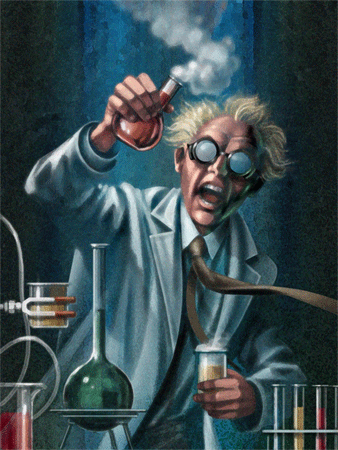 ver been a high priority, as researchers themselves prefer research, and there has always been science writers to serve as a medium.This might be why so many Americans hear "scientist" and think of something like this:
<------------
when, in reality, so many of us are
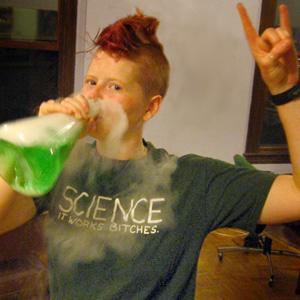
more like this --------------->
Okay, not always beakers, but beer pints instead, and not as much dyed hair. But we do rock the fuck out.
Anyway, the book. In the end, there really is no one place or person to hang all of the blame for the problems with how Americans do or do not embrace science. For all that we bemoan and cringe at the actively antiscience population, the truth is that most of our countrymen (and women) are actually very respectful of science and interested when it does pop-up in an understandable form. What is necessary is a new culture, which is actually quite fortunate, as American culture has shown us, it is malleable and powerful when concentrated. Let's not let this decade's ascendancy of the geek stop with a complacency that the Bush years are over, there is always a great amount of work to be done. It can always be better. Both scientists and Americans are defined by a strong attachment and dedication to consistent, hard work. Both are capable.
04 February, 2008
Super-extra-special-two-for-one-mega-Tuesday!
Okay, that's not for another twelve hours, when the polls open, but there is a buzz about America today. I hope that anyone who is reading this has gone out to their local polling place and cast their ballot (if able, not all of us are lucky enough to live in an open primary state). The important part is that you vote. The next most important part is that I see lots and lots of support for Senator Barack Obama, both here in Massachusetts and around the rest of the land.
I tend to wave optimist in (probably) too many things in my life, but seeing the interest today among my students in the democratic process was extremely satisfying. And this rant has suddenly become a stream-of-consciousness babble.
Nonetheless, I share in the excitement. And it's not just because I watch politics like normal people watch football. There are record numbers and interest in the primary season which has not been seen in my lifetime (I believe that NPR cited 1980 as the last time). Even people who often could not care less about these things are talking about debate performance, stance on issues, and the future decade for America and the world.
I hope that this keeps-- the natural cynic in me serves as a reminder that the hype around the primaries will die along with the anointment of the nominees (in all likelihood this week), and there will be a glut of interest until November, when we return to our <50% voter rates, etc. We seek so often for our Enlightened Republic.
Yet, I am a hopeless optimist. Let's watch tomorrow
Okay, that's not for another twelve hours, when the polls open, but there is a buzz about America today. I hope that anyone who is reading this has gone out to their local polling place and cast their ballot (if able, not all of us are lucky enough to live in an open primary state). The important part is that you vote. The next most important part is that I see lots and lots of support for Senator Barack Obama, both here in Massachusetts and around the rest of the land.
I tend to wave optimist in (probably) too many things in my life, but seeing the interest today among my students in the democratic process was extremely satisfying. And this rant has suddenly become a stream-of-consciousness babble.
Nonetheless, I share in the excitement. And it's not just because I watch politics like normal people watch football. There are record numbers and interest in the primary season which has not been seen in my lifetime (I believe that NPR cited 1980 as the last time). Even people who often could not care less about these things are talking about debate performance, stance on issues, and the future decade for America and the world.
I hope that this keeps-- the natural cynic in me serves as a reminder that the hype around the primaries will die along with the anointment of the nominees (in all likelihood this week), and there will be a glut of interest until November, when we return to our <50% voter rates, etc. We seek so often for our Enlightened Republic.
Yet, I am a hopeless optimist. Let's watch tomorrow
Subscribe to:
Posts (Atom)