Mr g by Alan Lightman
Writing good fiction is hard. Writing good science is even harder. From what I've come across over the years, science-based fiction (not science fiction) is a rare talent to be praised. Mr Lightman began his career as a physicist, specializing in astrophysics, and for twenty years, held a distinguished career in astronomy through MIT.
Then he started writing. With previous (and somewhat esoteric) work such as Einstein's Dreams and Good Benito, Lightman's talents have come to lay in weaving descriptive prose with a scientist's curious and detailed view of the Universe.
Which brings us to Mr g.The unnamed narrator, at the beginning of the book, wakes up from a very long nap and decides to create a universe. In this story of Creation as told from the perspective of the Creator, we can see the development of geometric, scientific, mathematical, and physical ideas as the narrator builds concepts such as space and time from the infinite nothingness of the Void, where he lives with his argumentative aunt and uncle. The creator is at his core a curious personality, learning by trial-and-error as he builds, and rebuilds universes of varying dimension, geometries, logical consistences, and stability. He loves to watch his creations simply grow and change, and see how they react to stimuli, such as introduction of "organizational principles" and laws of physics.
His favorite project begins with Aalam-104729 (the name originates with His Uncle Deva's penchant for creative naming, and the 10,000th prime number, so he doesn't lose track of it amid the billions of other universes), which His Aunt Penelope randomly selects for him, encouraging that He "take His time with this one, and not rush into things." As Mr g (He is never actually referred to as such in the book, but I'm running out of things to call Him) launches Aalam-104729 by enriching it with symmetry concepts, a simple three dimensions of space, physical laws, and finally matter, which erupts in a fantastic explosion, He is delighted to simply watch his creation grow.
As a strict non-interventionist, the narrator is highly concerned with proper cause-and-effect, in which His own actions should not meddle with the internal workings as the universe unfolds of its own accord, and in a beautiful chaos, developing elementary particles, stars, planets, and eventually biology. His foil, however, has a somewhat more active philosophy. Soon after the creation of Aalam-104729, the tall, whip-smart, and elusive Belhor arrives with an interest in the new creation. While not "the devil" per se, Belhor represents Mr g's intellectual equal, who often serves as a balancing sounding board for ideas concerning thornier issues when conscious life arises, such as morality, and the overarching philosophy of a "disinterested" god who allows beings to suffer.
Perhaps the most compelling moral discussion in the novel is the narrator's discussion with His uncle, who is lobbying for the creation of an immortal soul for conscious beings; the creator is hesitant, well-knowing that a mind from the material universe would not be able to comprehend the Void beyond existence. With input from Belhor, and Uncle Deva, the idea of the beings having an actual connection beyond their universe is a heavy decision for the creator.
While being an exceptionally quick read, Lightman's work weaves together concepts ranging wide from mathematics, science, and philosophy, as taken by someone who has very good reason to consider the impacts of each of His ideas. The science, form the Big Bang to the End, is wonderfully expressed in the text as we read the life story of the universe, and its creator's pure love for all that it is. This is an excellent read for anyone with even a passing interest in philosophy or science, with a shift of perspective to the Outside which only a deity could appreciate
Showing posts with label down the rabbit hole. Show all posts
Showing posts with label down the rabbit hole. Show all posts
07 March, 2012

03 January, 2010
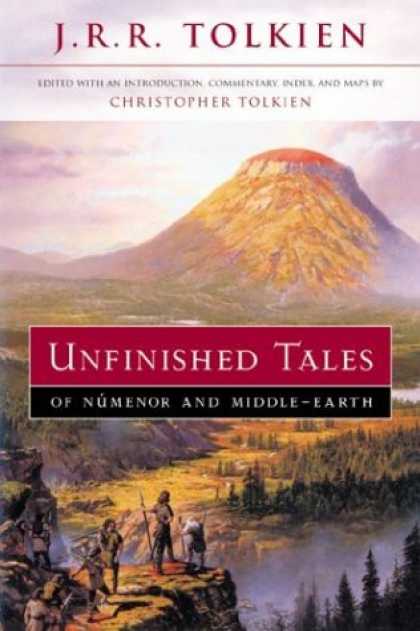
Unfinished Tales by J.R.R. Tolkien
How appropriate, upon doing some research on the author for this review, I discovered that today, January 3, is his eleventy-eighth birthday! Sooner or later, a biography of the sage of Middle-Earth must be added to the ever-growing reading list.
Known by and large for the legendary (in every sense) Lord of the Rings, and The Hobbit, John Ronald Reuel Tolkien created and sustained a full universe inhabited by an illustrious, plenary and vibrant mythology. Having read the "core" Tolkien works, which comprise of the previously mentioned two, as well as the posthumously published Silmarillion, one understands with the wealth of tales in Middle-earth, that when the author passed away at the age of 81, he left myriad stories of this world left untold and uncompleted.
While LotR (1954-5) told of the great War of the Ring and its lead-up/impacts in the Third Age of Middle-earth, The Silmarillion (complied throughout a lifetime, and published by his son Christopher in 1977) sets the stage of creation for Middle-earth telling the stories the Valar (gods), the first Eldar (elves) and Atani (men), and their epic struggles of the First and Second Ages. Between these epics of high fantasy, Tolkien establishes a deep mythology and society within his work, beautifully self-consistent and interconnected to a tapestry of pure legend.
This is where Unfinished Tales begins. Not to be taken lightly, I strongly advise approaching LotR and The Silmarillion as prerequisite reading for Tolkien's in-depth work. Compiled in the years following his father's death, Christopher Tolkien has done a marvelous job of stitching together his father's fragmented, scattered, and often illegible notes about the history of Middle-earth. It had been a habit of the late Mr. Tolkien to half-write many stories, often heavily annotated with present and future edits, as he fastidiously combed-over them to discern their final form and their proper place in his legendarium. Scraps of paper, the back of maps, and scattered notebooks left in J.R.R. Tolkien's collection stretching from 1911 to his death in 1973 have been brought together with his son's dedicated work as a marvelous gestalt
which thoroughly textures the vibrant world of Arda.
Absolutely written for a pure Tolkien fan, this book almost demands prior knowledge of the Rings, Númenor, Beleriand, the Valar, and the people therein. I would not fault someone for being put-off by such a request for a reading, but this book may easily pull the reader deeper into the illustrious world and mythology of Middle-earth.
Moreover, for the detail-oriented geek in all of us, the text brings the "origin stories" (or at least the scattered ideas thereof) of several characters known to the Lord of the Rings trilogy such as Galadriel, Gandalf, and even the realms of Gondor and Rohan. For the sake of adding incredible depth to an already-existent world-structure, Unfinished Tales leaves the reader with a sense of having lived throughout the Ages of the world, watching events unfold with the sight of of a palantír and eternity and wisdom of Eru Ilúvatar.
As the title would indicate, however, these are in fact, unfinished. Annotated linguistically, historically, and literately by Christopher Tolkien, far too many of the tales are half-written accounts (despite the editor's best intentions of knowing the mind of his father), leaving the reader eager for a greater account of the legends. If nothing else, the reader finds lament and frustration that the author was unable to fully illustrate his ideas and stories.
One can deeply respect Tolkien for having the courage and talent to demand that readers travel deep into his world, and few authors, are capable of this. Take Tolkien warily, and he will take you on journeys. Despite the frustration of partial (and occasionally contradictory) stories, as well as history and geography demanded on my part, the absolute tolkienist in me looks forward to the twelve-volume Book of Lost Tales. See you then.
Namárië
25 March, 2008
Linux is always an adventure. My iBook is starting to show it's age and I had to bring it in for physical repairs
(on day 1,050 out of 1095 of the warranty), so I'm using my 2001 college desktop-now-frankenstein-Linux machine.
What I love about getting "up to your elbows" in a computer's workings is how a simple measure can delightfully exponentiate into ridiculousness. "Oh, the clock is off by 7 minutes" turned into "why doesn't java work?" turned into rooting around in root to figure out how to get it right... long story short, in what should have been a 10-second adjustment (checking time.gov and resetting the clock) turned into a 20-minute exploration of getting stuff to work in Ubuntu. Rarely do I ever turn off this machine without having felt that I learned something about Unix.
A bit busy today (with god knows what....) I hope that I'll update on this soon!
PS-- while I look for a new laptop, does anyone have any suggestions?
(on day 1,050 out of 1095 of the warranty), so I'm using my 2001 college desktop-now-frankenstein-Linux machine.
What I love about getting "up to your elbows" in a computer's workings is how a simple measure can delightfully exponentiate into ridiculousness. "Oh, the clock is off by 7 minutes" turned into "why doesn't java work?" turned into rooting around in root to figure out how to get it right... long story short, in what should have been a 10-second adjustment (checking time.gov and resetting the clock) turned into a 20-minute exploration of getting stuff to work in Ubuntu. Rarely do I ever turn off this machine without having felt that I learned something about Unix.
A bit busy today (with god knows what....) I hope that I'll update on this soon!
PS-- while I look for a new laptop, does anyone have any suggestions?
Subscribe to:
Posts (Atom)