22 June, 2012

Fahrenheit 451

Yes, yes I'm late. As usual.

Two weeks ago, we lost one of the titans of science fiction, Ray Bradbury. As one of the four "greats" of science fiction (along with Asimov, Clark, and Heinlein), Bradbury brought science fiction writing out of the discount bin, regulated to weirdos and futurists, and allowed the genre to mature into a defined literary field.

Moreover, Bradbury's work in his later years proved him to be the best kind of old man-- a crotchety, opinionated, I-don't-care-anymore loudmouth. I can only aspire to such a thing come mid-century. In particular, Bradbury had a fierce commitment to public libraries as institutions existing to the betterment of all mankind, even dismissing formal education in place of the honored biblioteque,

"Libraries raised me. I don't believe in colleges and universities. I believe in libraries because most students don't have any money. When I graduated from high school, it was during the Depression and we had no money. I couldn't go to college, so I went to the library three days a week for 10 years."

Wow, isn't that the way it should be? I heard his echoes every time our town debated building a new library. 
As much time as his mind spent in the future, Bradbury was suspicious of the Internet, at one point responding to a request to digitize his books by saying, "To hell with you. To hell with you and to hell with the internet.", citing that "it isn't real." Indeed, the flow of knowledge was a topic close to his heart, leading to last week's re-read of the classic Fahrenheit 451.

Intended as a story not about burning books, but what happens to a society which no longer cares about deep thinking, this was Bradbury's launch from magazine serials to literary analysis. The plot itself is straightforward enough (most likely recalled from our high school days, whether this was assigned reading or not); Guy Montag is a "fireman," in that his purpose in this vaguely-defined 21st century dystopia is to burn the remaining books in the city.

Guy's world begins to bifurcate upon meeting Clarisse McClellan, a free-spirited seventeen year-old, whose family is highly suspect in clinging to the "old ways" such as talking, going on leisurely walks and drives, generally avoiding television, and asking "why" a bit too often to make people comfortable. In a society wherein the populace is entirely disconnected from one another, and to a large degree, themselves, Clarisse exposes Guy's suppressed, questioning spirit with which the fireman begins to wonder at the books, ideas, and -- by extension-- people which he has sought to destroy.

While the writing, particularly in part three of the book, leans more toward "adventure story," the message is where the story shines. In an adult's reading, I found interesting, the state of Millie, Guy's lassitude wife. Utterly dependent on the structure of the society, she is a waif of a soul, entirely unable to think more deeply on any topic beyond a nervous laugh, or derisive dismissal. Although written in 1951, the disengagement of the general public, more focused on soundbites and factoids than analysis and connections, one can see why Bradbury developed an irritation with 2009's state of the Internet.

And that's probably why Fahrenheit 451 leapt from the dregs of "genre" to become assigned reading in secondary and post-secondary analysis; its application. As a reader in 2012, one likely sees as many warning signs in the world around them as a reader in 1962 or 2075. Moreover, Bradbury's storytelling is an artful experience, stretching to ideals to which all of us reach-- the pursuit of beauty and truth.


07 March, 2012

Mr g by Alan Lightman

Writing good fiction is hard. Writing good science is even harder. From what I've come across over the years, science-based fiction (not science fiction) is a rare talent to be praised. Mr Lightman began his career as a physicist, specializing in astrophysics, and for twenty years, held a distinguished career in astronomy through MIT.

Then he started writing. With previous (and somewhat esoteric) work such as Einstein's Dreams and Good Benito, Lightman's talents have come to lay in weaving descriptive prose with a scientist's curious and detailed view of the Universe.

Which brings us to Mr g.The unnamed narrator, at the beginning of the book,  wakes up from a very long nap and decides to create a universe. In this story of Creation as told from the perspective of the Creator, we can see the development of geometric, scientific, mathematical, and physical ideas as the narrator builds concepts such as space and time from the infinite nothingness of the Void, where he lives with his argumentative aunt and uncle. The creator is at his core a curious personality, learning by trial-and-error as he builds, and rebuilds universes of varying dimension, geometries, logical consistences, and stability. He loves to watch his creations simply grow and change, and see how they react to stimuli, such as introduction of "organizational principles" and laws of physics.

His favorite project begins with Aalam-104729 (the name originates with His Uncle Deva's penchant for creative naming, and the 10,000th prime number, so he doesn't lose track of it amid the billions of other universes), which His Aunt Penelope randomly selects for him, encouraging that He "take His time with this one, and not rush into things." As Mr g (He is never actually referred to as such in the book, but I'm running out of things to call Him) launches Aalam-104729 by enriching it with symmetry concepts, a simple three dimensions of space, physical laws, and finally matter, which erupts in a fantastic explosion, He is delighted to simply watch his creation grow.

As a strict non-interventionist, the narrator is highly concerned with proper cause-and-effect, in which His own actions should not meddle with the internal workings as the universe unfolds of its own accord, and in a beautiful chaos, developing elementary particles, stars, planets, and eventually biology. His foil, however, has a somewhat more active philosophy. Soon after the creation of Aalam-104729, the tall, whip-smart, and elusive Belhor arrives with an interest in the new creation. While not "the devil" per se, Belhor represents Mr g's intellectual equal, who often serves as a balancing sounding board for ideas concerning thornier issues when conscious life arises, such as morality, and the overarching philosophy of a "disinterested" god who allows beings to suffer.

Perhaps the most compelling moral discussion in the novel is the narrator's discussion with His uncle, who is lobbying for the creation of an immortal soul for conscious beings; the creator is hesitant, well-knowing that a mind from the material universe would not be able to comprehend the Void beyond existence. With input from Belhor, and Uncle Deva, the idea of the beings having an actual connection beyond their universe is a heavy decision for the creator.

While being an exceptionally quick read, Lightman's work weaves together concepts ranging wide from mathematics, science, and philosophy, as taken by someone who has very good reason to consider the impacts of each of His ideas. The science, form the Big Bang to the End, is wonderfully expressed in the text as we read the life story of the universe, and its creator's pure love for all that it is. This is an excellent read for anyone with even a passing interest in philosophy or science, with a shift of perspective to the Outside which only a deity could appreciate


25 February, 2012

Wow, that is a crappily-rendered banner, isn't it?

06 November, 2011

Well, it looks like I will hopefully get the book reviews up-and-running again soon. Currently, I'm in the middle of the "Song of Ice and Fire" series by George R.R. Martin, "History of Middle Earth" set of Tolkien, 1493 by Charles Mann, and Badass: Birth of a Legend by Ben Thompson. I hope to finish one of these soon.

Also, speaking of writing, I am currently trying to participate in National Novel Writing Month, a 30-day blitz to write 50,000 words. Check out the zoo exhibit at my other blog, The Great Ocean Sea. I'm a bit hastened at the moment, but more details to follow!

02 November, 2011

Holy crap.

Blogger added some neat tools such that I can check where the site's audience is coming from, and I was fairly blown away to learn that there is a lot more people reading this blog than I thought.

I guess that I'd better update more

19 November, 2010

So he's starting this again...

I took a break for a bit. The time was right, and I had finished what I had to say for the moment. However, I'm looking forward to making this a regular habit again, with some other experiments that I've been toying with for some time. Most are still evolving, some will soon be ripe for the light of day, and one (if you ask politely) you can see in its Petri dish.

Specifically, it would be really nice to get the book reviews again. Since last February, a lot of interesting titles (and re-reads) such as House of Leaves, Lord of the Rings, Absurdisation, and 1984. Every now and again, it feels nice to return to a well-worm favorite novel.

All things said, to write is to feel good. It can often be depressing to realize how low the ratio is of the culture you create to the culture which you consume; even the act of inane web-postings is like watching the release of a dammed river.

Let's see if this starts...

17 February, 2010


The Fourth Part of the World: The Race to the Ends of the Earth and the Epic Story of the Map That Gave America Its Name by Toby Lester

What is the scale of the world? The first recorded answer to this was in the 3rd century BCE by Eratosthenes, a Alexandrian Greek astronomer/geographer who measured the circumference of the Earth to be 39,375 km (the actual value is 40,075 km-- that's less than 1% error!).

Geography as a discipline, is one which in the post-modern era, has little meaning as compared to ages past. Today, "geography" brings to mind memorizing maps, continents, and locations easily accessible conceptually (and usually, physically) on the well-measured and explored contours of our planet. To a more formal definition, the modern geographer utilizes computer modeling to study the human-environment relationship.

However, in the world of Eratosthenes, Ptolemy, and geographers for more than a millennium, contrasting the known size of our world with how little is known of it sets the study of maps and their intrinsic meaning holds a both philosophical and adventurous call. The map, of course, is the original player's guide for ages past; in the truest sense of what a map should do, the proper cartographical guide should be your itenerary, your travel-log, your translator, and your fortune-teller for the journey not yet begun.

The reader cannot truly appreciate a "story of a map" until one readers the first few chapters of Lester's book. Outright, The Fourth Part of the World is the backstory and tale of the the Waldseemüller map, the centerpiece of a 1507 revision of Ptolemy's Geography, which holds the historical distinction of being the first document which (1) recognizes the New World as a separate continent, and not an eastward extension of Asia and (2) identifies this new landmass as "America" for the first time.

While the map itself has its own beginning and ending (curiously disappearing for nearly 400 years) which brings it to the Library of Congress today, the tale behind the map is a sojourn on the scale of centuries which encompasses Western history from the Fall of Rome to the dawn of the Age of Exploration. Set firmly in the Eurocentric mindset of exploration (the Mongols, Songhai, and Arawaks knew just where they lived, thank you very much), the seeds of cartographic expansion begin with the great conquest of Eurasia in the thirteenth century by Genghis Khan.

When the Mongols hit the geopolitical landscape of the 1200s, they changed everything-- a disciplined military force which could strike like a legion and scatter like bandits. Often, the Mongol Empire is associated with Chinese and Central Asian history, but their effects were (for the time) global. Like dominoes from Japan to Ireland, one kingdom's fall affected all those around them until the percolation of the Khan's influence reached the Vatican.

In grade school, the canonical rationale for the beginning of the Age of Exploration was late Medieval trade with the Middle-East; Lester argues, however, that the primary motivator for the eastern reach of Latin Europe was political-- the Turkish expansion in Anatola in the 11th and 12th centuries (which ultimately triggered the Crusades) pressed Greek (Byzantine) Christians too much for Latin Europe's comfort.

While the European conception of the Far East was steeped in mythology and fantasy, they often looked to the East for salvation. The East was the beginning of light and hope, not only a geographic interpretation, but philosophical and religious as well-- theologians of the day saw history as an expansion from east to west, as the sun marches across the sky. The oriens ultima was the Edenic earthly paradise from which the Next Coming, the religious hoped, would arrive to unify the world under their faith. Mythic figures such as Prester John, to save the world to Gog and Magog, to destroy it, inhabited the lands of the silk-worms and long-lived.

Seeking alliance with the growing Empire (a Christian redeemer perhaps?) who seemed to scare the Islamic states threatening Christian Europe, Popes, kings, and adventurers looked to the land of the Great Khan for the future. The mythic figures stopped being those of fantasy, such as Prester John, and began to be flesh-and-blood adventurers such as Marco Polo and Friar William.

Philosophically, the cosmology of the late Medieval era was concise-- the world existed as three major pieces of land (Europa, Africa, Asia) rising out of the watery sphere of the sea. Contrary to what is commonly taught about pre-Columbian thought, it was well-known in Europe since the Classical Era that Earth was in fact a sphere. Jerusalem was the theological and physical center of the world, where the continents essentially met, and the Ptolemaic spheres of the heavens moved above.

As the Latin Europeans sought to fill in the gaps in their three-part world, the Earth as we know it began to unfold for Western culture. Perhaps it is because so much of history post-Columbus is canon in school curriculum, the story of exploration begins to lose a bit of its luster-of-the-unknown when the Genoan Admiral arrives on the scene. Throughout the work, there is a steady progression of storyline from Middle Age philosophers such as Franciscan monks and early Papal emissaries to China to the Portuguese hugging the African coast (enslaving along the way), the lucky wanderers (Christopher Columbus), and shameless self-promoters as Amerigo Vespucci. This narrative weaves an intriguing tapestry of exploration and cultural growth.

Vespucci's journey itself was the Fourth Part which rocked the philosophical grounds of the era. Columbus' "discovery," at its own time, was throught to be a relatively minor success, as many thought that his islands happened to be a second set of Canaries. Sailing to latitudes over 50 degrees south of the equator had put Amerigo's ship at the fabled Antipodes of the Earth, a fourth land to redefine the deep islands of the Atlantic. This expanding world, embraced by the growing humanist movement across Europe exploded the Renaissance, and the first viable attempts in over a thousand years to revive the Roman Empire sprung to life; with this, two German thinkers-- Martin Waldseemuller and Matthias Ringmann-- proposed a new edition of Ptolemy's world-defining work.

A philosophical work about humankind's literal and theological place on Earth, The Fourth Part of the World is a journey of the mind and spirit as much as it was across the sea. Exploration is a sincerely human endeavor, which has always been more than finding a new land beyond your view, but within oneself. Growth of the soul is always more fascinating than growth of the maps. The heroism of economic and social subjection are not to be glorified as the men who were not the explorers, but the quiet students of cosmology who studied and wrote in the libraries, monasteries, and universities back on the Continent. These philosophers (in the truest sense of the word) drew the new bounds and directions of thought for the coming centuries. To pore over a map is to explore within and without.

And, if you're lucky, you get something named after you.

30 January, 2010


Order of the Stick by Rich Burlew (http://www.giantitp.com/comics/oots.html)

Inside all of us, there is a little bit of gamer nerd. For Rich Burlew, that nerd is two-dimensional and stick-figured. Beginning in 2003 as an aside from Burlew's gaming site, Giant In the Playground, Order of the Stick began as a series of poorly-drawn in-jokes with the Dungeons & Dragons community, but the comic has grown over the last few years in include a wider audience of non-gamers, while keeping its heart and mind set firmly in the universe of where so many outcomes are determined by the Game Master's whim and the multisided die.

Following the travails of your canonical adventuring party, OOTS has grown into a textured world with equally textured characters and storylines of the same quality as one which A Gm lovingly been pieces together for the enjoyment of himself and his players. As necessary for any D&D story, the scale of the adventurer's journey is no less than epic, with the very whole of creation in the scales of balance as the party seeks to defeat the lawful evil Xykon and contain the chaotic wrath of the Snarl. Going well beyond the simple race-class-level descriptors of characters, the comic creates a meta-gaming experience through character backstories, relationships, and theology.

The basis of Order of the Stick's jokes-- as backed-up by lowbrow high fantasy-- has always been based in poking fun at the game as the players so often do (e.g., characters are quite aware of their level, stats, feats, and how well they did or did not do on that last spot-check). Although heavy-handed in the D&D jokes, the strip appeals to non-gamers alike, often setting the atmosphere to interest and invite would-bes to the game itself. Indeed, the poorly-drawn world which the adventurers inhabit, in fact, has become one of the running jokes of the strip, with both the author and characters well-aware of their one-dimensional proportions, taking note of when their creator shifts with any new artistic style or character clothing. As for an artistic critique, the stylization itself has modified somewhat over the last few years, with the cartoonist utilizing differing media for the Creation Story, but has otherwise remained static, keeping to the simplistic roots.

While the update schedule once followed a Monday-Wednesday-Friday series, one can now count on Burlew's updates at least once per week, the scheduling having been on a bit of a sliding scale for the past few years. While this is often a sin in the webcomic community (nonetheless, one which drives me mad), I can give Rich Burlew a pass, as he has been suffering from an undisclosed illness for a few years; in recent months, however, the updates schedule has improved.

Admittedly, I have not yet gotten a chance to take a look at Order of the Stick's related six books (which include many origin tales, and side-stories in addition to the strips), I do look forward to pick them up one of these days to fill-out the remains of the storyline (Although one can do well-without the formulaic romantic subplot). In addition to the usual commentary on the gaming world (great tribute the late Gary Gygax in 2008 as well), the strip has introduced general geek humor, bringing Harry Potter and Dune into the adventure when the time calls for it.

This one speaks to the inner nerd in us, and feeds on the absolute geekiness with no apologies, and congratulates you on that new d20 you bought, and challenges you on the rules and opinions of 4th Edition.

Roll for initiative.

Humor: B
Artwork: C-
Plotline: A+
Characters: B
Schedule: D+
Creativity: A-

28 January, 2010

J.D. Salinger died today. He passed away in his home in New Hampshire at the age of 91.

Seems appropriate on a day like this. I'm not sure what the whether is like in New Hampshire today, but in Massachusetts today, it was a still, soft snow that left all lines-- tree limbs, wires, and fences -- iced as if designed. As usual, it was cold, but unlike the wind what one pictures biting in Manhattan in December of '51, it wasn't bitter.

To most of the world, Salinger had been dead for a long time-- almost mythic in his decades-long seclusion, which almost appeared to be in resonance with his most well-known character, Salinger had thrown off the world. It is wrong, however, to embody our antihero is his creator; Holden will always be sixteen and confused and disenchanted, and in love with the world, and this is why we hold onto him. There's more than one reason why I re-read Catcher in the Rye in December.

In all likelihood, Mr. Salinger you will not want much made of his passing, and this blog will not join the myriad obituaries. So many of us never got a chance to thank you for your creation and your inspiration that touched that part of our mind who has no patience for irreverence or selfishness or selling out. Thank you for displaying beauty and agape in a broken young man. Thank you for making the worst student in my class part of my conscience.

24 January, 2010


Food Rules: An Eater's Manual by Michael Pollan

Sometimes, you need some ground rules, sometimes simple ideas need to be spelled-out orderly and succinctly for one to take notice. Learning how to eat again is no different.

Author of the bestseller, The Omnivore's Dilemma, and it's distilled version, In Defense of Food, Pollan has further refined his arguments and crusade for mindful food into a slim, 140-page list of sixty-four rules to keep as a pocket guide for your meals, or a conscience sitting on your shoulder as you devour another can of Pringles.

A writer who had been most likely at the forefront of the "slow food" ethos which has begun to arise in recent years, Pollan has been a guru of sorts to a small group of Americans who have seen food, eating, and cuisine move farther and farther from its natural purposes of (1) nourishment and (2) enjoyment. In fact, much of the thesis of the earlier Omnivore's Dilemma is "why do we eat?" from which the reader begins to consider what foods are "worth" eating. I realize that the last sentence sounds a bit condescending, but the emphasis of the books is more of the nature where food is approached as an experience, rather than a necessity-- something to be enjoyed rather than simply done.

(in addition to those mentioned above, the 2001 Botany of Desire: A Plant's-eye View of the World is worth picking up)

As for the text itself, I was reminded of the Tao Te Ching of Lao Tzu in the simplicity and straightforwardness of its advice: Eat food, mostly plants, not too much. All of the text (as well as the other two above) can be boiled down to those three simple directions. The rules themselves in Food Rules are elaborations on each of these points, often just as simple (avoid food products that contain more than five ingredients; pay more, eat less; spend as much time enjoying a meal as it took to prepare it), which in fact, need little explanation in of themselves.

The spare "directions" for selecting what you eat, how you eat, and why you eat it are koan-like in their nature, as they were meant to be something you can mutter to yourself in the kitchen, rather than ideological advice to be preached. Often, the reader's great-grandmother is invoked, as a ghost born over a century ago clucking over your shoulder about whether or not you need that second cookie, or asking why you didn't eat your vegetables, or simply being uncertain as to what Pop Tarts are and how they should be eaten. Like the manner in which the advice is given, the advice itself is simple in that it asks for simplicity-- would anyone be able to recognize GoGurt or Squeez Bacon or this thing as a food in 1910?

By this point, my review has likely not been longer than the book itself. Brevity is an art in writing when it is well-done; read this book because for no other reason that you can do it in an hour. For a time-to-read/quality-of-material quantification, Food Rules is well-worth your investment (not to mention that I also bought the book for about $7 too).

You get out of life exactly what you put into it; your dinner plate is no different.

21 January, 2010

59 > 41


The unfortunate part about writing before you go to bed is that as consciousness flees from your mind, and escaping with it is general cohesion and argument in any discussion. This is well-evidenced by my previous post.

To pick-up where it left off, the simple matter is that there are parliamentary tricks to deal with this situation. It is very likely, in fact, that any filibuster will be made at all-- this sort of stalling tactic is precisely that which no one needs, putting all incumbents in danger this November. The Republicans might be in the minority now, but there are 34 senators* who are not terribly interested in joining the growing unemployed numbers among their constituents.

*Interesting note-- of these 34, eighteen are Republicans and sixteen are Democrats. Even if we assume a total overturn in Senate elections this fall, this places the Democrats at a now 61 vote advantage with eighteen fresh faces. Nate Silver, you have inspired me.

Psychologically, it takes a lot to stand up and scream "No! This is who I am and you cannot change me!", and I will give this to the GOP. In fact, the psychological antonyms to this are such things as: consideration, empathy, avoiding conflict, avoiding extremes, thoughtfulness and reflection; those general trademarks of the left. It seems since the second red scare of seventy years ago, the progressives of American politics have been afraid of their own shadow-- their own belief. In the end (as so much of politics do), this comes down to high school sociology; a desire to move with the herd represses one natural tendancies. For so long, the left has played the game as defined by the right.... they have tried to be strong Democrats by either trying to be (1) the same as or (2) subservient to the Republican party.

Let the left be the left. Progressive has a meaning beyond its buzzwordiness.

19 January, 2010

Filibuster.

Let them do it. Tonight was a disappointment to progressives across the country, but no less pinching in the Commonwealth this evening. While one can look upon the Brown-Coakley race with our glasses-less hindsight, this is looking into the future.

On last night's Daily Show, Jon Stewart, the jester speaking truth to authority put the situation delicately "Democrats will only have an 18-vote majority in the Senate, which is more than George W. Bush ever had when he did whatever the fuck he wanted." (note: the strongest Republican Senate during the last administration was 55 majority in 2003-4). Nonetheless, the upper house of Congress is designed to operate on a strict majority vote. Last week, the New York Times published a great article discussion the constitutionality of this parliamentary maneuver, in particularly how this effectively negates the Vice President's one of two functions. So why is the filibuster in existence? One may argue that in the grand tradition of Mr. Smith Goes to Washington, this provides a platform on which the minority will never lose their voice in a tyranny and a possible steamrolling by the majority. A few years ago, in fact, when the dominant Republican party was discussing "the nuclear option," wherein the filibuster was to be destroyed, Democrats were rightfully offended.

So let the Republicans have it. If there is one thing that Americans have no patience for, it is legislative inaction. While the control of the 111th Congress has been doing a fine job of this all by themselves, as soon as the minority "party of No," rushes to scream as loud as it can with its 41st vote, this tactic can only explode in their face. Not only will this grind healthcare reform to a halt, but the senate Republicans will take the spotlight.

While proper analysis is necessary, why is this not an option? One may picture the minority party screaming like a petulant child, throwing a tantrum until they at last fall asleep. Let their own legislative exhaustion exhibit itself. An eighteen-vote majority is more than enough to accomplish the Democratic Senate's goals.

A majority simply needs fifty.

Comments welcome

18 January, 2010

Updates abound! Yes, the promised reviews aren't in, but I felt the Haiti has more than taken prominence this week over my half-spell checked rants about books. [Please, please, please support aid efforts if you can but clicking the link above]

So let's begin critiquing the internet. To begin this quasi-periodical series of webcomic reviews, is a very old one, and one of the first which I began following in 2003 or so, Nukees by Darren Bleuel.

Following the adventures of a group of nuclear engineering (Nuc.E) graduate students, I took to this easily given various references to physics humor (yes, us geeks have our own jokes), and somewhat skewed reality. The story lines and humor centers upon Gav, whom is best described as the megalomaniacal mad scientist wannabe whom establishes himself as Alpha geek in the Stanford engineering department.

As any good webcomics geek should, digging into the archives places one in the AOL-era Internet of 1997 when Bleuel (a then grad student at the university) began posting his campus newspaper a generalized slice-of-life strip regarding departmental humor, (grad) student life, and campus culture. Through the late nineties and early aughts, however, Nukees quickly departs into a somewhat surreal development of Gav and his friends as they explore and exploit the world through the power of a gigantic robotic ant, journeys through the legal system, the afterlife, relationships, beer, and other general metaphysical entities.

Written for the pure science nerd at heart, Nukees has kept it's fan-base of physics and engineering geeks at the core of humor, in spite of the frequent wanderings in the plot line. In particular, one would be remiss to forget Bleuel's arguably greatest contribution to geek culture, Agnostica, created within the Nukees world in the December of 1999. Beginning on December 14 (the 99th anniversary of the presentation of Planck's theory of quantized energy-- the birth of quantum physics), and extending to an indeterminate date (in consideration with the Uncertainty Principle), Agnostica is a fiercely secular celebration of logic, the beauty of the natural world, uncertainty, and ultimately, the spirit of giving. Amazingly, this self-prclaimed geek holiday has curiously sprung-up within certain circles with joyous celebration of physics, math, and glögg.

Although Bleuel's work has clearly undergone metamorphoses through the last thirteen years, the strip itself (both in artistic style and writing) peaked somewhere in the range of 2002-2004, and has in recent years been relatively static on both these accounts. While there has been a greater degree of character development since mid-decade, many of the plots tend of be of the nature of rambling episodes which stretch over the course of months to get to any sort of conclusion. The slice-of-life style of the early strip is now long passed, and the innate weirdness of particular plots (Giant Ant, Danny's Inferno) have seemed to given way to relatively weak stories wherein the reader, at most times, in unsure as to the direction and ultimate point of the author's intentions. While the whole of the story-arc has been sub-divided into sixty-odd pieces, these "chapters" are generally only defined long after they have been completed, making introduction for new readers difficult. While site design isn't particularly something of which I take note (so long as I can find what I'm looking for), Nukees.com has a very strong Web 1.0 feel, having undergone little revision in many years (news updates are seasonal at best).

This is not to say that Bleuel has done a poor job. As one of the longest-running comics I read, Nukees has a distinct credibility in never posting late. While Gav began as a loose caricature of the author, the years have since proven Gavauthor to have real-life capacities far beyond that of Gavcharacter in organizing the Keenspot network of webcomics (through which I discovered Nukees), the International Random Bag of Fun (see "Agnostica"), his own research, in addition to the regular strip and its book, Nukees: d/dx.

Final call: more physics, less drama. Keep the funny
Grades:

Humor: B
Artwork: C+
Story lines: B-
Characters: B
Schedule: A+
Creativity: B-

13 January, 2010

I know that I promised webcomic reviews, but please take the time to find aid for Haiti. Goodness knows that life isn't easy there in the best of times.

One of my favorite site for donation is Doctors Without Borders , which puts something like 90 cents per dollar worth of contributions into actual aid. They're global, quick, and highly competent.
To a lesser extent, check out the International Red Cross/Red Crescent, or many other aid programs, but be sure they're legitimate!

Please donate what you can

10 January, 2010

The biggest problem with employment is that performing a task for money severely hinders my time for books. Between the December 23 and January 2, I was able to take-down and review at least three readings, and was able to get started on several more. In fact, in the time that I've run this quasi-periodical rant, there's been a definite time compenent to posting frequency with school vacations. The issue remains that I would like to post on a regular basis, but my duties elsewhere draw away from time which can always be better spent reading (most times in life are, in fact, improved with a book in hand).

So Tilting at Windmills will embark on a new adventure for the next couple of weeks, where reviews of webcomics-- my daily dose of small-scale reading regularity (ah, alliteration!). As webcomics go, familiarity and reading-times are not issues, just finding time to write them up will be the key to providing daily updates. While I'm not too sure how many readers out there (all 3 of you) participate in the webcomics subculture, but there is a strong following within the geek community, and I'll see how this goes. As always, I'm looking for input; there are about fifteen posts which I have in mind to begin with, but if you have any suggestions, I'm more than happy to broaden my horizons.

Incidentally, the books will probably slow down for a while (see working above), but I randomly found a nonfiction about maps of all things, which has been nerdishly addictive. Additionally, I've finally started House of Leaves, which I've been looking forward to for a while. I look forward to reviewing both soon.

03 January, 2010


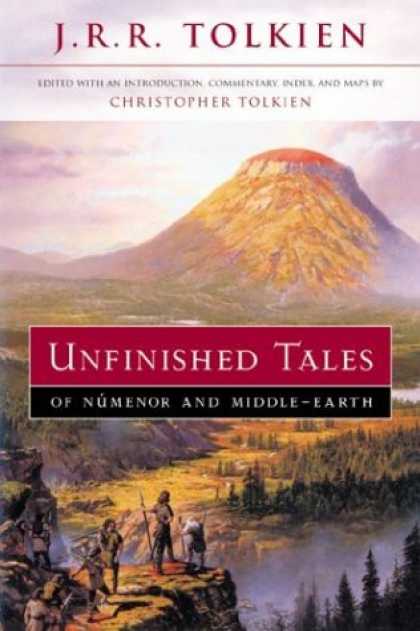
Unfinished Tales by J.R.R. Tolkien

How appropriate, upon doing some research on the author for this review, I discovered that today, January 3, is his eleventy-eighth birthday! Sooner or later, a biography of the sage of Middle-Earth must be added to the ever-growing reading list.

Known by and large for the legendary (in every sense) Lord of the Rings, and The Hobbit, John Ronald Reuel Tolkien created and sustained a full universe inhabited by an illustrious, plenary and vibrant mythology. Having read the "core" Tolkien works, which comprise of the previously mentioned two, as well as the posthumously published Silmarillion, one understands with the wealth of tales in Middle-earth, that when the author passed away at the age of 81, he left myriad stories of this world left untold and uncompleted.

While LotR (1954-5) told of the great War of the Ring and its lead-up/impacts in the Third Age of Middle-earth, The Silmarillion (complied throughout a lifetime, and published by his son Christopher in 1977) sets the stage of creation for Middle-earth telling the stories the Valar (gods), the first Eldar (elves) and Atani (men), and their epic struggles of the First and Second Ages. Between these epics of high fantasy, Tolkien establishes a deep mythology and society within his work, beautifully self-consistent and interconnected to a tapestry of pure legend.

This is where Unfinished Tales begins. Not to be taken lightly, I strongly advise approaching LotR and The Silmarillion as prerequisite reading for Tolkien's in-depth work. Compiled in the years following his father's death, Christopher Tolkien has done a marvelous job of stitching together his father's fragmented, scattered, and often illegible notes about the history of Middle-earth. It had been a habit of the late Mr. Tolkien to half-write many stories, often heavily annotated with present and future edits, as he fastidiously combed-over them to discern their final form and their proper place in his legendarium. Scraps of paper, the back of maps, and scattered notebooks left in J.R.R. Tolkien's collection stretching from 1911 to his death in 1973 have been brought together with his son's dedicated work as a marvelous gestalt
which thoroughly textures the vibrant world of Arda.

Absolutely written for a pure Tolkien fan, this book almost demands prior knowledge of the Rings, Númenor, Beleriand, the Valar, and the people therein. I would not fault someone for being put-off by such a request for a reading, but this book may easily pull the reader deeper into the illustrious world and mythology of Middle-earth.

Moreover, for the detail-oriented geek in all of us, the text brings the "origin stories" (or at least the scattered ideas thereof) of several characters known to the Lord of the Rings trilogy such as Galadriel, Gandalf, and even the realms of Gondor and Rohan. For the sake of adding incredible depth to an already-existent world-structure, Unfinished Tales leaves the reader with a sense of having lived throughout the Ages of the world, watching events unfold with the sight of of a palantír and eternity and wisdom of Eru Ilúvatar.

As the title would indicate, however, these are in fact, unfinished. Annotated linguistically, historically, and literately by Christopher Tolkien, far too many of the tales are half-written accounts (despite the editor's best intentions of knowing the mind of his father), leaving the reader eager for a greater account of the legends. If nothing else, the reader finds lament and frustration that the author was unable to fully illustrate his ideas and stories.

One can deeply respect Tolkien for having the courage and talent to demand that readers travel deep into his world, and few authors, are capable of this. Take Tolkien warily, and he will take you on journeys. Despite the frustration of partial (and occasionally contradictory) stories, as well as history and geography demanded on my part, the absolute tolkienist in me looks forward to the twelve-volume Book of Lost Tales. See you then.

Namárië

26 December, 2009


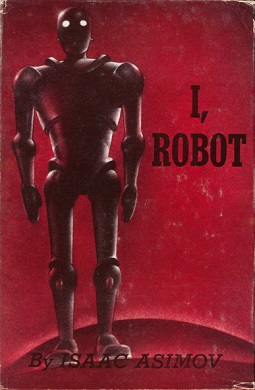
I, Robot by Isaac Asimov

To begin with, while there are many editions of many books out there, the cover art that normally goes up with these reviews is that of the edition which I read. The physical book beside me right now is the 2004 printing, which my brother loaned to me (thanks Will!). Unfortunately, this was the same year in which a film of the same title, that had little to do with the novel, premiered. As I was holding a cheap paperback in which Will Smith glared at me with a vaguely futuristic and ominous, if worried countenance.

{damnit, Will Smith, cut that out}

Firstly, just about anyone who has read Asimov places him as the father of modern science fiction, and from what I have read of his early work (Foundation trilogy, "Nightfall"), I can agree an overflowing imagination and use of fundamental science are the principles of his work are highlights of Asimovian sci-fi.

More than anything else, Asimov constructs an entire universe around his fiction, in which he employs a similar method as Foundation, as telling his narrative through a series of thematically-related, chronological short stories. The novel itself takes the form of a 2064 interview of the elderly Dr. Susan Calvin, a roboticist who shepherded the dawn of the robotic age. Dr. Calvin's second- and first-hand recollections of twenty-first century history from the simple robotics in the 1990s to the global-scale positronic brains of the 2060s is a series of accounts in which the human creators struggle with, understand, and learn about their own creations through the regular, logical actions of the machines.

Dr. Calvin herself is always described in the text as cold and emotionless, moreso than even her robotic subjects. The ever-logical and steadfast nature of this personality characterizes the book. Central to any of Asimov's description of robotkind are the Three Laws of Robotics:
  1. A robot may not harm a human being, or through inaction, allow a human being to come to harm
  2. A robot must obey any orders given by a human being, unless such orders conflict with the First Law
  3. A robot must protect its own existence, unless doing so conflicts with the First or Second Law
In fact, these Laws are so central to not only robots' existence, but are also entirely central to the plot of the book. Each of the nine short stories are reflections of how humans and robots interact with these Laws, and in each of the nine stories, the reader is consistently reminded of the Laws' text and importance. To be honest, it was a bit irritating after a while (I found myself screaming "Get on with it!" each time the characters reviewed these laws).

The concept of robopsychology as Calvin's field of study seems a bit abstract to me. As the entirety of robot's "personalities" are dictated by the Three Laws (and occasionally hints of the zeroth), one would think that any personality the robot would have would be rather straightforward and predictable, but then again, most of the stories in I, Robot are peculiar cases where behavior is unexplained. Or, I could study a bit more about artificial intelligence, even though it's always made me a bit paranoid. While Asimov's ideals about the Laws dictating all robotic behavior are wonderful (especially the bit about the positronic brain melting before harming a person), I feel that the real history of AI tilts to a more pragmatic robot which gets the job done, as programmed by its creators. Let's not forget that we do live in the future, after all.

The author should not be begrudged praise... this is a finely written book, with an excellent imagination for the era (1950), and if anything, I'm a bit disappointed that robots are not as benign and just as Asimov had hoped. At parts it is a dry read when compared to his more colorful work; but in truth, Asimov was a scientist by training, who saw the world as thoroughly organized and beautiful; while is work wonderfully operates within the laws of nature, I feel he greatly restrained endless possibilities of development by restricting the story to additionally operate within the laws of robotics.

Both the central character's and author's endless reverence for the positronic brain is appreciated, but as it is seen to some degree with Dr. Asmiov and to an almost misanthropic degree with Dr. Calvin, there was an overarching theme that the innate "goodness" of robots was always greater and more concrete than the goodness, abilities and creativity of mankind. Sure, the robots are infinitely rational and selfless and obedient, but don't count humans out of the game just yet. In the constructed 21st century of the novel, I'm probably one of the cranky old Fundamentalists who don't trust the mechanical men. I'm okay with that though (I'm going to be one of those awesome old guys who's always ranting about something and shaking a cane.... kids of the 2050s, watch out).

In fact, the developing field of artificial intelligence in all likelihood places what will be the real world's equivalent of the positronic brain in an interactive console that a move-around humanoid machine. Although no futurist (ask Ray Kurzweil for more details), the next decade or two will be staggerinly fascinating when a synthetic mind can consider us as we consider it. A field developing faster than the common press can keep up, this brings so much of what "science fiction" is to our daily lives. As usual, the only thing more fascinating than the dreams of fiction writers is when these are written by history.

To finish off, let's hope that these Three Laws do get programmed into our future mechanical overlords, and that we remind them that we are a good, benevolent race of squishy irrationals.

24 December, 2009

The Revolution Will Not be Medicated
Today's news from the senate chamber is no less than fantastic. Really, I'm happy to see any motion on healthcare reform whatsoever; but to a very specific degree, does anyone else feel that this victory is Pyrrhic? Both the House and the Senate bills, which have yet to be reconciled, were near party-line votes (60-39 in Senate and 220-215 in the House) are the result of compromise followed by compromise, to the point where, while this bill will have its effects, no one really seemed happy with the end result.

Too often when learning/reading/listening about the healthcare debate, I want to throw my hands in the air and forget about it because, simply stated, where is this all going? Would a reform be e true revolution which is necessary. Regardless of one's political ilk, virtually everyone agrees that an overhaul is absolutely necessary, but there is severe disagreement about what to do about Americans' health insurance.

Throw it out.

That's it, throw it out. A certain, calming epiphany when I realized that this was the path-- healthcare needs a complete paradigm shift, a total revolution as to its purpose and existence. Why are we insured at all?
in·sur·ance
1 Coverage by contract whereby one party undertakes to indemnify or guarantee another against loss by a specified contingency or peril
By definition, insurance is an agreed-upon, businesslike gamble. There's nothing wrong with this... in fact, much of modern life and commerce owes functionality to someone gambling that bad things won't happen. Every year, I spend hundreds of dollars on a gamble that I might find myself in an automobile accident-- I'm happy to have lost this wager every year, but it's nice to know that if I "win" and get the insurance company to pay out, it'll be helpful in the aftermath. All insurance is simply a gamble-- this is why certain religious groups such as the Amish and some Muslims do not participate in conventional forms.

Say what you will about gambling... coming from a town that relies on it, I see it as a fun vice when in control (as any other vice), but in the end, Americans can usually tell a good bet from a bad bet. I can wager that I won't crash my car or burn down my house by taking precautionary measures, and the respective insurance companies won't have to pay; in fact, I can continue being safe like this for years or even decades. Health is something entirely different-- sooner or later, everyone taking part in seeing a doctor or an ER or having a baby or whathaveyou.... it's a rare case when an one's odds of losing is 100% on a long enough time-scale.

So the insurance company always loses... and then passes the losses back onto everyone else. It's a guaranteed cycle, under which too many people have figured out how to make money. Now making money's not bad, it's the American Way, after all, but I do not need to renumerate the costs of what the healthcare industry does.

Simply stated, betting against not being sick is an outdated model for insurance companies. Even the insurance companies know this by now, as they no longer brand themselves as insurance industry, but healthcare industry. Keeping one's health no longer a gamble, it must be a service. Homeowner's insurance does not stop my house from being on fire, the community-supported firehouse does. Insurance policies are not without purpose, but where they are now, they are just in the way.

When I was about 10, I considered emergency services, which I think at the time was defined as "when someone is involved with sirens." Aware that the police and fire departments were a part of the city government, I asked my father about ambulances and hospitals being a part of the same structure of public services. He made a remark about the First Lady that I didn't really understand, but I remained even more confused that not dying was something for which you were given a bill.

Rules for insurers, public insurance, reformed insurance. Same song, new chorus. The fundamental idea of how Americans think of how we take care of ourselves simply needs change. This will come, assuredly, but not now; nor will it be easy.

The Revolution Will Not be Medicated.

22 December, 2009


Unscientific America by Chris Mooney and Sheril Kirshenbaum

My process for reading books is never quite as fast as I would like it to be... this inevitably results in always adding more to the eternally growing list of to-reads. For this reason, as much as I enjoy books of the zeitgiest, they too often loose their great impact before I get a chance to comb through the pages. Unscientific America, in this mold, operates very much within the moment; clearly researched in late 2008, and written/published in early 2009, Mooney & Kirshenbaum's work is an extension from Mooney's 2005 Republican War on Science (recommended reading). However, rather than taking aim at a particular political philosophy, the authors have a greater focus upon the American people's malaise and insouciance of the scientific world.

A relatively short work (about 150 pages), but very clear and to the point, the book rose from the failed effort of ScienceDebate2008, an effort during the 2008 presidential election to bring Senators Obama and McCain to a forum in which the scientific issues of the day were discussed (in the same way of the values debate, economy debate, etc...). The Obama campaign politely declined requests, and the McCain camp simply ignored any discussion of the topic. Good idea though, right? A lot of universities, professional researchers, and members of the educated community thought so too. The simple reason why the campaigns declined (or ignored) the idea of discussing American science in a highly public forum was that there was no reason to-- a presidential campaign is purely an animal of survival-- the quadrennial campaign is as lean and as close to public sentiment as metaphorically possible.
But why don't Americans like to talk about science?

"Of course we're intimidated by science! Science holds itself above everybody else-- above God, evidently. You guys have been kicking ass since the Enlightenment"
-Stephen Colbert

A quick history of the American relationship with the scientific community through the latter half of the 20th century (although not as cutting or encompassing as in Mooney's earlier work) brings us to the state of science of 2009, after eight years of an outright antiscience adminstration, culture wars on man's origin, stem cells, and some topics you would never think would be debated, to ask where are we now, and where are we going?

[For a full jeremiad about the declining place of science in America, please see older posts.]

While it would be easy to place blame upon the populace for scientific lassitude, Mooney and Kirshenbaum are equanimitous in spreading blame to scientists for popular disconnect. While American interest in scientific advances have consistently slipped in that last fifty years, science itself has become more obtuse-- beautiful, encompassing, and wonderful-- but largely abstract to the general population.

Communication of science, the authors argue, is the greatest failing of the American science-culture system. While science writers have been declining in the waning years of newspapers, the scientists themselves are often left to communicate the wonder of their art to the people, which has simply never been a high priority, as researchers themselves prefer research, and there has always been science writers to serve as a medium.This might be why so many Americans hear "scientist" and think of something like this:
<------------

when, in reality, so many of us are
more like this --------------->

Okay, not always beakers, but beer pints instead, and not as much dyed hair. But we do rock the fuck out.


Anyway, the book. In the end, there really is no one place or person to hang all of the blame for the problems with how Americans do or do not embrace science. For all that we bemoan and cringe at the actively antiscience population, the truth is that most of our countrymen (and women) are actually very respectful of science and interested when it does pop-up in an understandable form. What is necessary is a new culture, which is actually quite fortunate, as American culture has shown us, it is malleable and powerful when concentrated. Let's not let this decade's ascendancy of the geek stop with a complacency that the Bush years are over, there is always a great amount of work to be done. It can always be better. Both scientists and Americans are defined by a strong attachment and dedication to consistent, hard work. Both are capable.

21 December, 2009

Mentioned yesterday that I was feeling rather philosophical, and I think I'll explore that again. Unfortunately, there's been about 24 hours' worth of lag-time, and I can't quite recall where I was going with such thoughts.

Let's see, yesterday, I wrote about Avatar, so let's see where that takes us...

"Avatar" itself is the Sanskrit word for incarnation, or manifestation as in a god's physical manifestation on Earth. Funny how in the general translations, Christ is never referred to as an avatar, or "god in the flesh." Funny how that comes to mind as I write this week of Christmas (speaking of which, Happy Solstice, everyone).

Religios interpretations aside, the term today has come to represent not so much a manifestation, but as a projection. I can go onto my Facebook friends' list and find at least a half dozen WoW avatars, not to mention the myriad other games where this is commonplace. Moreover, in so many facets of today, our avatar is, in fact, often our digital projection to the world-- it is the form we choose to take in social media, MMOs, message boards, podcasts, YouTube channels, or even of characters in tabletop RPGs

What do we choose to project? So many of us have found Facebook to be a fine replacement for the Class Reunions of generations past (personally, I'm on the fence about what I'd do with a Class of '01 invite). Friends, acquaintances, even enemies are brought together via Walls and Apps and Games which span from the melodramatic years of high school to the quasi-established "adults" which so many of us have become ("and of my goodness, so-and-so has a baby!"). Who are we? Many are mindful of our web-presence, and the most careful of us minutely scrutinize personal information disseminated to the Web.... but where is the line between dissemination and scrubbing?

There are no shortages of anecdotal tales about embarrassing information posted by oneself or one's friends, but from what we control, what is chosen?
"This profile photo hides my double-chin,"
"Am I in a relationship, or an it's-complicated?"
"Why should I post that I still have the same job I did at 18?"
"Let's just make sure that everyone knows I have a Master's degree"
and what is that line between our avatars, the personalities we want others to see, and who we truly are?

Cinematically, an excellent addressing of this idea stretches back a decade (yes, friends, it has been a decade) to 1999's The Matrix. Although this metaphor is quite literally backward-- in The Matrix, we live as digital projections ignorant of our physical reality-- many points still hold. Consider the "residual self-image," how do you truly view yourself? Your mind's projection of your physical appearance... what is seen in the psychological mirror? And do we bend our image to our will, or better yet (as shown by Neo), is our image of the world bent to us? Okay, it probably stretches my point to the edge of breaking, but the question remains.... what is our projection?

In the end, so much of our daily avatars move back to the ancient interpretation-- the mundane actions of a god. As gods of our own universe, like Neo, we define our reality by our interpretation of it; it goes without saying that a physical reality exists of its own accord regardless of whatever interpretations we have have, but as the image which we project to the world, and that of the world which our mind projects to ourselves, one asks, how are these reconciled? Can they be? Should they be?

What's your avatar?